
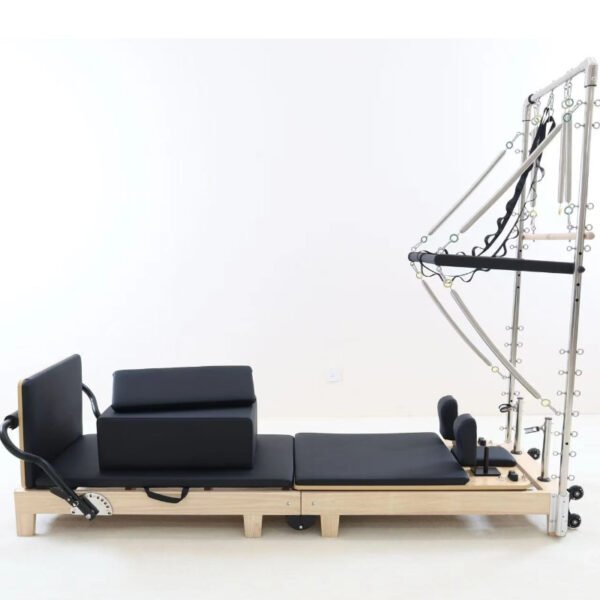
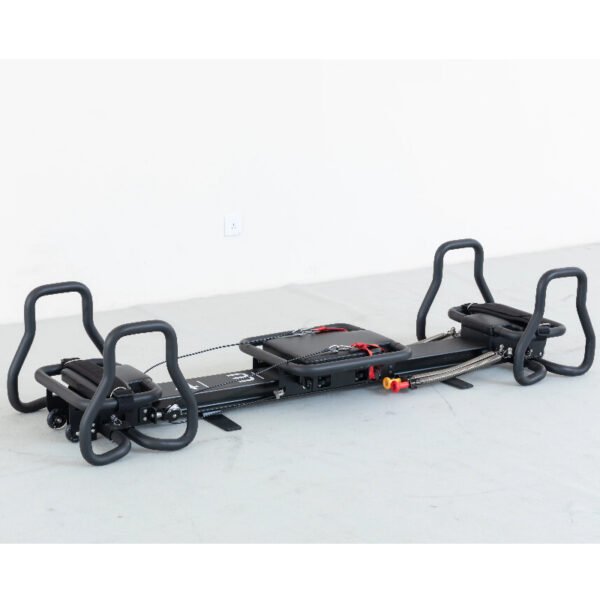


If you’ve been exploring Pilates or low-impact strength training, you’ve probably come across two machines that look surprisingly similar: the Pilates Reformer and the Megaformer.
Both feature a sliding carriage, spring-based resistance, and multiple ways to challenge your muscles. But despite their similar appearance, they are designed for different workout experiences.
When comparing Reformer vs Megaformer, the biggest differences come down to training philosophy, equipment design, exercise intensity, and fitness goals.
A Pilates Reformer is designed for controlled movement, core strength, flexibility, and full-body conditioning. A Megaformer, on the other hand, is specialized equipment developed for the Lagree Method, which emphasizes slow movements, sustained muscular tension, and high-intensity, low-impact training.
So, is a Megaformer better than a Reformer? Which machine is more suitable for beginners? And what should Pilates studio owners consider before investing in either type of equipment?
This guide explains how both machines work, compares their benefits, and helps you choose the right option for your training needs or fitness business.
Reformer vs Megaformer: Quick Comparison
Before exploring each machine in detail, here’s a side-by-side look at the key differences between a Pilates Reformer and a Megaformer.
| Feature | Pilates Reformer | Megaformer |
| Primary training method | Pilates | Lagree Method |
| Main focus | Strength, mobility, alignment, and control | Muscular endurance, sustained tension, and conditioning |
| Workout intensity | Low to high, depending on programming | Typically high |
| Movement style | Controlled movements with varied tempos | Very slow movements with continuous tension |
| Resistance | Adjustable spring resistance | Adjustable spring resistance |
| Equipment design | Sliding carriage, footbar, straps, and springs | Sliding carriage, multiple platforms, handles, and springs |
| Rest periods | Vary by class and instructor | Typically short transitions |
| Beginner-friendly | Yes, with appropriate instruction | Yes, with suitable modifications |
| Low-impact | Yes | Yes |
| Typical users | Pilates practitioners, home users, and studios | Lagree participants and specialized fitness studios |
| Best suited for | Versatile Pilates training and progressive conditioning | Challenging, endurance-focused workouts |
Both machines can support effective full-body workouts. However, the better choice depends on your goals, experience, and preferred training style.
What Is a Reformer?
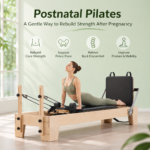
A Pilates Reformer is a specialized exercise machine originally developed by Joseph Pilates to support controlled, resistance-based movement.
It consists of a rectangular frame with a carriage that moves along rails. Springs provide adjustable resistance, while straps, pulleys, and a footbar allow users to perform exercises in different positions.
Unlike traditional gym machines that often focus on individual muscle groups, a Pilates Reformer encourages coordinated movement throughout the body.
Exercises can be performed while lying down, sitting, kneeling, or standing, making the machine suitable for a wide range of training needs.
How Does a Pilates Reformer Work?
The Reformer uses springs to create resistance as the carriage moves along its frame.
Users push or pull against the springs using their arms, legs, or body weight. By adjusting spring tension, body position, and exercise complexity, instructors can customize the difficulty.
Common Reformer exercises include:
Footwork: Strengthens the legs and improves lower-body alignment.
Leg circles: Challenges hip mobility and pelvic stability.
The Hundred: Develops abdominal endurance and breathing coordination.
Long stretch variations: Strengthen the shoulders, arms, and core.
Bridging exercises: Engage the glutes, hamstrings, and spinal stabilizers.
The emphasis is not simply on moving the carriage back and forth. Effective Reformer Pilates requires precision, coordination, breathing, and controlled muscle engagement.
What Are the Benefits of Reformer Pilates?
- Improves Core Strength and Stability
Many Reformer exercises require the abdominal and back muscles to stabilize the torso while the arms or legs move.
- Supports Flexibility and Mobility
The machine allows users to explore controlled ranges of motion while working against adjustable resistance.
- Develops Balanced Muscular Strength
Reformer Pilates challenges the upper body, lower body, and core through a wide variety of exercises.
- Offers Adaptable, Low-Impact Exercise
Spring resistance and exercise positioning can be modified for different abilities. This makes the Reformer useful for beginners, experienced practitioners, and appropriately supervised clinical exercise programs.
- Encourages Better Movement Awareness
Reformer training emphasizes body alignment, coordination, and precise movement patterns, which can carry over into everyday activities and other forms of exercise.
For people seeking a versatile workout that combines strength, mobility, and body control, the Pilates Reformer is an excellent option.
What Is a Megaformer?
A Megaformer is a specialized spring-resistance exercise machine developed by Sebastien Lagree for the Lagree Method.
Although it resembles a Pilates Reformer, the Megaformer is designed for a different approach to exercise.
Rather than following the traditional Pilates repertoire, Lagree workouts focus on slow, controlled movements performed under sustained muscular tension.
The goal is to challenge strength, muscular endurance, stability, and cardiovascular fitness within a demanding, low-impact workout.
A Megaformer typically includes a moving carriage, spring resistance, platforms, and multiple handles that allow users to perform exercises from different positions.
Its equipment layout supports a variety of standing, kneeling, and full-body resistance exercises.
How Does a Megaformer Work?
The Megaformer uses spring resistance and a sliding carriage to create challenging movements that require continuous muscle engagement.
One of the defining characteristics of Lagree training is time under tension.
Instead of completing repetitions as quickly as possible, participants perform exercises at a deliberately slow pace. This increases the time their muscles must work against resistance.
For example, a lower-body movement may require the user to maintain a challenging position while slowly moving the carriage.
Even a small movement can become demanding when the muscles remain engaged for an extended period.
Lagree classes also tend to use short transitions between exercises, allowing participants to maintain a relatively high level of effort throughout the session.
What Are the Benefits of Megaformer Workouts?
- Builds Muscular Endurance
Sustained resistance challenges muscles to continue working over longer periods.
- Develops Full-Body Strength
Many movements require multiple muscle groups to work together, including the legs, glutes, core, shoulders, and arms.
- Provides Challenging Low-Impact Conditioning
Megaformer workouts can feel intense without relying on jumping or other repetitive high-impact movements.
- Improves Stability and Coordination
The combination of a moving carriage, resistance, and different body positions challenges balance and body control.
- Offers an Efficient Training Format
Lagree workouts combine strength-focused movements and sustained effort in a structured session, appealing to people who prefer challenging, time-efficient workouts.
However, workout intensity varies according to the instructor, exercise selection, resistance, and individual fitness level.
It is also important to distinguish authentic Megaformer equipment from other spring-resistance training machines. Megaformer is a registered trademark of Lagree Fitness, and similar-looking equipment from other manufacturers should not automatically be described as official Megaformers.
Megaformer vs Reformer: 6 Key Differences Explained
Although both machines use spring resistance, the differences become much clearer when you look at how they are designed and used.
1. Equipment Design and Structure
A traditional Pilates Reformer usually features a long frame, sliding carriage, footbar, shoulder rests, springs, and pulley-operated straps.
This design supports a wide variety of Pilates exercises, from foundational movements to advanced strength and mobility work.
A Megaformer features additional platforms, handles, and exercise positioning options designed around Lagree training.
These differences influence how users move, where they position their bodies, and how instructors structure exercises.
2. Workout Intensity
One of the most noticeable differences between a Megaformer and a Reformer is the typical intensity of the workout.
Reformer Pilates can range from gentle, technique-focused sessions to demanding athletic workouts.
Megaformer classes are generally structured to maintain muscular tension and create significant physical fatigue.
However, a Megaformer workout is not automatically more difficult than every Reformer workout. An advanced Pilates session can also be extremely challenging.
3. Movement Speed and Training Style
Reformer Pilates uses controlled movements, with tempo varying according to the exercise and teaching approach.
Some exercises involve smooth, continuous movement, while others require pauses or slower repetitions.
Megaformer workouts place particular emphasis on slow movements and prolonged muscular engagement.
Although the exercises themselves are performed slowly, transitions between movements are often relatively quick.
This combination can make the workout feel physically demanding.
4. Muscle Engagement and Training Goals
Both machines can strengthen the core, legs, glutes, shoulders, and arms.
The difference is how those muscles are challenged.
Reformer Pilates emphasizes movement quality, balanced muscular development, stability, and coordination.
Megaformer training emphasizes sustained resistance, muscular endurance, and maintaining effort through challenging exercise sequences.
Neither approach is inherently superior. They simply prioritize different aspects of physical fitness.
5. Flexibility and Mobility
Reformer Pilates offers a broad exercise repertoire that can support flexibility, mobility, and controlled joint movement.
Stretching and mobility exercises can be integrated directly into a Reformer session.
Megaformer workouts may also challenge flexibility and mobility, but these are generally not the primary focus of a typical Lagree class.
For someone whose main goal is to improve movement quality and flexibility, Reformer Pilates may be a more natural starting point.
6. Exercise Variety and Class Experience
A Pilates Reformer supports a wide range of exercises in lying, seated, kneeling, and standing positions.
Depending on the instructor and program, sessions may focus on fundamentals, athletic conditioning, or specialized movement goals.
Megaformer classes follow the principles of the Lagree Method, using specialized equipment and exercise sequences designed to challenge muscular endurance.
As a result, the two classes can feel very different even though both involve springs and moving platforms.
Reformer vs Megaformer: Which Is Better for Your Fitness Goals?
Choosing the right machine depends less on which one is more intense and more on what you want to achieve.
For Core Strength and Stability
Both machines can help develop core strength.
Reformer Pilates places particular emphasis on controlled spinal and pelvic positioning, breathing, and coordinated movement.
Megaformer workouts challenge the core through prolonged resistance exercises that often require the entire body to remain stable.
If you want to improve body awareness and movement control, a Reformer may be particularly appealing.
If you prefer demanding full-body resistance training, Megaformer workouts may be a better match.
For Building Muscle and Improving Definition
Both Reformer Pilates and Megaformer workouts can contribute to muscular strength and endurance.
Megaformer training frequently emphasizes sustained muscular tension, which can create a strong feeling of muscular fatigue.
However, fatigue alone does not guarantee greater muscle growth.
Visible muscle definition depends on several factors, including training consistency, resistance progression, nutrition, and body composition.
For substantial muscle hypertrophy, either workout may need to be supplemented with progressive resistance training.
For Weight Loss and Calorie Burning
Megaformer classes often involve sustained effort and short transitions, which can increase the cardiovascular demand of a workout.
However, it would be misleading to assume that every Megaformer session burns more calories than every Reformer Pilates class.
Calorie expenditure depends on exercise intensity, session duration, body size, and individual effort.
Both forms of exercise can contribute to an active lifestyle and long-term weight management.
The most effective option is generally the one you enjoy enough to practice consistently.
For Flexibility, Mobility, and Posture
Reformer Pilates may be particularly suitable for people who want to combine strength training with mobility and movement awareness.
Its varied exercise repertoire allows instructors to address controlled movement, joint range of motion, and muscular coordination.
While Megaformer workouts also require body control, their primary emphasis is usually on strength and muscular endurance.
For Beginners
Beginners can participate in either type of training with appropriate instruction.
Reformer Pilates is often an accessible introduction to spring-resistance exercise because instructors can adjust movements and resistance levels.
Megaformer workouts can also be modified for newcomers, although the sustained muscular effort may feel challenging at first.
Regardless of the machine, beginners should prioritize qualified instruction and correct technique.
Is Megaformer Harder Than Reformer Pilates?
In many cases, a Megaformer workout may feel harder than a beginner or intermediate Reformer Pilates class.
This is mainly because Lagree training emphasizes prolonged muscular tension, slow movement, and relatively short transitions.
Participants may experience considerable muscle fatigue even when the movements appear small or simple.
However, difficulty is subjective.
An advanced Reformer Pilates class with challenging resistance, complex movements, and demanding balance exercises can be just as physically challenging.
The better question is not simply which workout is harder, but which training method aligns with your fitness goals and preferences.
Reformer vs Megaformer for Pilates Studios: Which Equipment Should You Choose?
For studio owners, the Reformer vs Megaformer decision involves more than personal workout preferences.
Equipment selection can influence your class offerings, instructor requirements, studio layout, operating costs, and target customers.
1. Consider Your Studio’s Training Concept
If your studio focuses on traditional or contemporary Pilates, a Pilates Reformer is usually the most appropriate choice.
It supports a wide range of class formats, including beginner instruction, group Pilates, private sessions, and athletic conditioning.
If your business intends to offer authentic Lagree classes, you need to consider official Lagree equipment, instructor education, and applicable licensing requirements.
Studios offering other forms of high-intensity spring-resistance training should distinguish their programs from the official Lagree Method.
2. Evaluate Your Target Customers
A Reformer-focused studio may appeal to customers interested in Pilates, mobility, posture, core strength, and progressive resistance training.
A high-intensity resistance training studio may attract customers who enjoy challenging strength-endurance workouts.
These audiences can overlap, but their expectations may differ.
Understanding your local market and preferred class format can help you choose equipment that supports your business model.
3. Compare Equipment Investment and Operating Costs
The purchase price is only one part of the total investment.
Studio owners should also consider equipment dimensions, delivery, installation, maintenance, replacement parts, instructor training, and ongoing support.
| Purchasing Factor | Pilates Reformer | Megaformer |
| Equipment investment | Varies by model, materials, and specifications | Depends on official model and purchasing arrangements |
| Training requirements | Qualified Pilates instruction | Appropriate Lagree-specific education for authentic Lagree classes |
| Studio space | Depends on machine dimensions and circulation space | Depends on model dimensions and exercise clearance |
| Maintenance | Springs, ropes, wheels, carriage, and upholstery | Springs, carriage, handles, platforms, and other model-specific components |
| Class versatility | Broad Pilates exercise repertoire | Specialized Lagree training |
| Business positioning | Pilates and movement-focused fitness | Specialized high-intensity, low-impact fitness |
Because specifications and prices vary, studio owners should request detailed quotations rather than relying on general cost assumptions.
4. Prioritize Equipment Quality and Durability
Commercial exercise equipment must withstand frequent use.
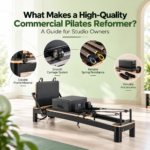
When evaluating a Pilates Reformer or another spring-resistance machine, pay attention to frame construction, carriage stability, resistance components, and overall build quality.
A well-designed machine should provide smooth movement, stable support, and accessible maintenance.
For professional studios, after-sales service and replacement-part availability are also important considerations.
5. Think About Long-Term Studio Growth
Before purchasing equipment, consider whether your chosen training format supports your future business plans.
For example, a Pilates studio may want to expand from private sessions into group classes.
Other businesses may develop specialized strength-conditioning programs.
Choosing equipment that matches your instructors’ expertise and your studio’s long-term direction can help avoid unnecessary replacement costs.
What Should You Look for When Buying a Pilates Reformer?
If you’ve decided that a Pilates Reformer is the better fit, the next step is evaluating the equipment itself.
Here are several features worth considering.
Frame Construction
Look for a stable, durable frame suitable for your intended level of use.
Commercial studios may prioritize construction that can withstand repeated daily sessions.
Smooth Carriage Movement
The carriage should move consistently along the rails without excessive vibration or unwanted lateral movement.
Smooth travel helps users perform controlled exercises comfortably.
Adjustable Spring Resistance
Different exercises and users require different resistance levels.
A practical spring system should allow instructors to make adjustments efficiently.
Comfort and Ergonomics
Carriage padding, shoulder rests, straps, and footbar positioning can influence the overall user experience.
Comfort is particularly important during longer training sessions.
Maintenance and Support
Consider how easily springs, ropes, wheels, and other wear components can be inspected or replaced.
For studio owners, dependable technical support can reduce equipment downtime.
At CoreFlow, we offer Pilates equipment options for different training environments, including home practice and professional studio use.
You can explore our Pilates equipment range to compare available designs and find a solution that suits your space and training requirements.
Can You Do Megaformer Exercises on a Pilates Reformer?
Some general resistance-training movements may look similar on both machines.
For example, both can involve planks, lunges, and exercises that challenge the core while the carriage moves.
However, a Pilates Reformer and a Megaformer are not interchangeable.
Differences in platform configuration, handles, carriage design, and exercise positioning affect how movements are performed.
Attempting to copy a specialized Megaformer exercise on a Reformer without suitable modifications may create unnecessary safety risks.
More importantly, performing a few similar exercises does not make a workout an authentic Lagree session.
The Lagree Method involves specific training principles, equipment, and instructor education.
For the best experience, use each machine according to its intended design and follow the guidance of a qualified instructor.
Can You Combine Reformer Pilates and Megaformer Workouts?
Yes. For many fitness enthusiasts, Reformer Pilates and Megaformer training can complement each other.
Reformer Pilates can provide opportunities to develop movement control, flexibility, coordination, and strength.
Megaformer workouts can add a different resistance-training challenge, particularly for muscular endurance.
For example, someone might incorporate Reformer Pilates sessions alongside occasional high-intensity resistance workouts, depending on their schedule and recovery needs.
There is no universal requirement to train on both machines.
A balanced fitness routine should reflect individual goals, exercise experience, and recovery capacity.
Reformer vs Megaformer: Which One Is Right for You?
Ultimately, the right choice depends on the kind of workout experience you want.
Choose a Pilates Reformer If You:
Want to improve core strength, flexibility, and body control.
Prefer a versatile exercise system with adjustable difficulty.
Enjoy movement-focused workouts with attention to alignment.
Are looking for Pilates equipment for home or studio use.
Want access to a broad range of Pilates exercises.
Choose a Megaformer If You:
Enjoy challenging, high-intensity, low-impact workouts.
Want to focus on muscular endurance and sustained resistance.
Prefer structured classes with continuous muscular effort.
Are interested specifically in the Lagree Method.
Enjoy specialized full-body conditioning workouts.
Neither machine is universally better.
A Pilates Reformer offers versatility across a broad range of Pilates training goals, while a Megaformer provides a specialized training experience built around the Lagree Method.
For studio owners, the most suitable investment will depend on the services they plan to offer and the customers they want to serve.
Frequently Asked Questions About Reformer vs Megaformer
What Is the Main Difference Between a Reformer and a Megaformer?
The main difference is their intended training method. A Pilates Reformer is designed for Pilates exercises emphasizing control, strength, mobility, and coordination. A Megaformer is designed for Lagree workouts emphasizing slow movements, sustained muscular tension, and high-intensity, low-impact conditioning.
Is a Megaformer the Same as a Pilates Reformer?
No. Although both machines use springs and a sliding carriage, they have different equipment configurations and support different training methods. The Megaformer is proprietary Lagree equipment, while the Pilates Reformer is designed for the Pilates exercise repertoire.
What Is a Megaformer Used For?
A Megaformer is used for Lagree training, which combines resistance exercises, muscular endurance, stability, and cardiovascular conditioning. Its platforms, handles, and moving carriage allow users to perform challenging full-body movements.
What Is a Reformer Used For?
A Pilates Reformer is used for resistance-based Pilates exercises that develop strength, mobility, stability, and movement control. It can accommodate a wide range of exercise positions and difficulty levels.
Is Megaformer Better Than Reformer Pilates for Building Muscle?
Neither machine is automatically better for muscle growth. Both can improve strength and muscular endurance. Significant muscle growth depends on factors such as resistance progression, training volume, nutrition, and recovery.
Can Beginners Use a Megaformer?
Yes. Beginners can participate in appropriately modified Megaformer classes with qualified instruction. However, the sustained muscular effort may feel demanding, especially for people who are new to resistance training.
Is Megaformer Pilates Actually Pilates?
No. Although the machines may look similar and some exercises share general movement patterns, the Lagree Method is distinct from Pilates. The term “Megaformer Pilates” is sometimes used informally, but it does not accurately describe the official training method.
Can a Pilates Reformer Replace a Megaformer?
Not completely. A Pilates Reformer can provide challenging full-body resistance training, but it does not reproduce every feature of a Megaformer or the complete Lagree training experience.
Which Machine Is Better for a Pilates Studio?
A Pilates Reformer is generally the more appropriate choice for studios offering traditional or contemporary Pilates classes. Studios planning to offer authentic Lagree training should evaluate official Lagree equipment, instructor qualifications, and applicable licensing requirements.
Final Thoughts: Reformer vs Megaformer
When comparing Reformer vs Megaformer, the most important thing to remember is that these machines are designed for different approaches to exercise.
The Pilates Reformer emphasizes controlled movement, balanced strength, flexibility, and coordination. Its versatility makes it suitable for a wide range of users, from beginners to experienced Pilates practitioners.
The Megaformer is designed for the Lagree Method, delivering a more specialized workout centered on slow movement, continuous muscular tension, and challenging low-impact conditioning.
Both can play a valuable role in a fitness routine, but the best choice depends on your goals and preferred training experience.
For Pilates studio owners and equipment buyers, selecting the right machine also means considering durability, available space, instructor expertise, and long-term business needs.
Looking for Pilates equipment for your home or studio?
Explore CoreFlow Pilates equipment or contact our team to discuss equipment options that match your training space and business requirements.

No comment