
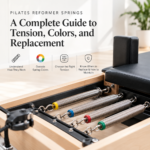






Pilates reformer springs may look like a simple part of the machine, but they have a major influence on how an exercise feels. The spring setting affects carriage resistance, stability, control, and the amount of assistance a user receives during a movement.
For beginners, one of the most common questions is, “Which Pilates reformer springs should I use?” The answer is not simply “use the lightest spring” or “use the heaviest spring.” Spring resistance depends on the reformer, the exercise, the user’s experience, and the manufacturer’s spring system.
It is also important to understand that Pilates reformer springs are not standardized across all brands. A red spring on one reformer may not provide the same resistance as a red spring on another.
This guide explains how Pilates springs work, what spring colors mean, how to choose an appropriate tension, when springs should be replaced, and how to maintain them safely.
What Are Pilates Reformer Springs and How Do They Work?
Pilates reformer springs are coiled metal springs that connect the carriage to the reformer’s spring bar or attachment points. Their main purpose is to provide resistance and, depending on the exercise, support and stability.
When the carriage moves away from its starting position, the springs extend and create tension. This means resistance can change throughout an exercise rather than remaining completely constant like a fixed weight.
For example, during footwork, stronger springs can provide substantial resistance as the user pushes the carriage away. In other movements, however, a lighter spring may require considerably more control because the carriage becomes easier to move.
This is why more spring tension does not automatically mean a harder Pilates workout.
The spring system also helps control the carriage when it returns toward the starting position. For exercises that require balance or precise movement, the right spring setting can make the difference between a controlled movement and one that feels unstable.
Most contemporary reformers use several springs with different resistance levels. Classical reformers can use a different approach, with multiple springs of similar resistance. Pilatesology notes that classical reformers commonly use springs with the same tension, while contemporary reformers often use color-coded springs with different resistance levels.
For anyone purchasing a new Pilates reformer, understanding the spring system is therefore just as useful as comparing the frame, carriage, footbar, and other components.
How Do Pilates Reformer Spring Colors and Tension Levels Work?
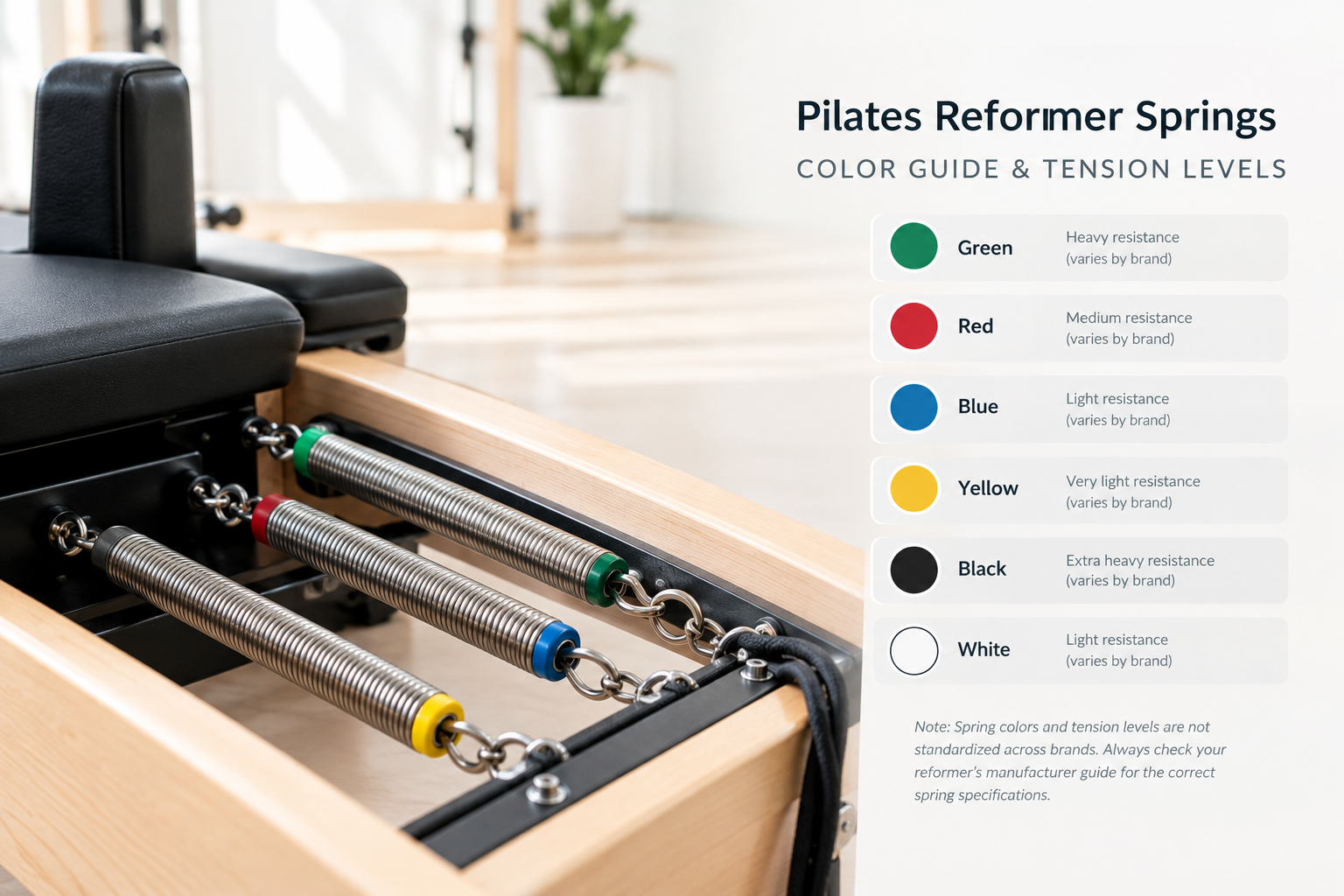
Many reformer Pilates springs are color-coded so users and instructors can quickly identify different resistance levels. However, the colors are not an industry-wide standard.
For example, Pilates Anytime lists different spring systems for several major manufacturers:
| Reformer brand/system | Example spring colors and resistance |
| Balanced Body | Green = heavy, Red = medium, Blue = light, Yellow = very light |
| Peak Pilates | Red = heavy, Yellow = medium, Blue = light |
| Merrithew | Black = extra-heavy, Red = heavy, Blue = medium, White = light |
| Flexia | Black = heavy, Blue = medium, Orange = light, White = extra-light |
These are examples rather than a universal Pilates spring chart. Pilates Anytime’s current guide also shows that some manufacturers use percentage-based tension systems, while others describe their springs simply as light, medium, heavy, or extra-heavy.
Why Don’t Pilates Reformer Spring Colors Mean the Same Thing Across Brands?
There is no universal rule saying that every red Pilates spring has the same resistance.
For instance, a red spring can represent medium resistance on one reformer and heavy resistance on another. Some manufacturers also use different numbers of springs or different spring combinations as part of their equipment design.
This is particularly important when ordering replacement Pilates springs online. Matching a replacement spring by color alone can lead to an incorrect setup.
Instead, check the reformer’s:
Manufacturer and model
Original spring specifications
Spring length and construction
Attachment style
Recommended spring combination
Manufacturer’s replacement instructions
Merrithew, for example, specifically states that its replacement parts are designed for Merrithew/STOTT PILATES equipment and will not fit equipment from other manufacturers.
How Do You Choose the Right Pilates Reformer Springs?
The right spring setting depends on more than the spring color. The exercise, user’s experience, body control, and reformer design all matter.
A practical way to approach spring selection is to start with the manufacturer’s recommended setting and then pay attention to how the movement feels.
For beginners
A beginner may benefit from more resistance during some exercises because stronger spring tension can provide additional support and help make the carriage more predictable.
However, this does not mean beginners should always use the heaviest springs. The appropriate setting should allow the user to maintain proper alignment and perform the movement with control.
For experienced users
Experienced practitioners may deliberately choose lighter resistance for certain exercises. A lighter spring can make the carriage less stable and require greater control from the core and stabilizing muscles.
Pilates Anytime notes that appropriate spring tension can vary according to factors such as a person’s height, weight, and skill level. It also recommends choosing a setting that allows the exercise to be performed with control, stability, and confidence.
For studios and instructors
A commercial Pilates studio may need to consider spring settings from a different perspective. Instructors may work with clients at very different skill levels during the same day, so having clearly identified and properly maintained spring options makes equipment setup easier.
For a new studio, it is worth asking the equipment manufacturer for a detailed spring chart before purchasing multiple reformers. This can help instructors establish consistent settings across machines.
Does a Heavier Spring Always Mean a Harder Workout?
No.
A heavier spring can make some exercises more demanding, but it can also provide additional support and stability. A lighter spring may make an exercise harder because the carriage is less supported and requires more control.
A simple example is an exercise where the user needs to stabilize the carriage. With a stronger spring, the carriage may feel more controlled. With a lighter spring, the user may need greater precision to prevent unwanted movement.
The better question is not “What is the heaviest spring I can use?” but rather:
“Which spring setting allows me to perform this exercise with the intended control and technique?”
If the spring makes it difficult to maintain alignment, the resistance may be inappropriate for that movement. If the carriage feels difficult to control, the setting may be too light.
When Should You Replace Pilates Reformer Springs?
Pilates springs are wear components. Their condition can change gradually with repeated stretching, environmental exposure, and frequent use.
There is no single replacement schedule that applies to every reformer. The manufacturer’s recommendation should take priority.
As a general reference, Pilates Anytime recommends replacing reformer springs when visible wear appears and gives two years as a general rule of thumb. Balanced Body’s equipment safety guidance similarly recommends replacing its springs at least every two years, while noting that usage and environmental conditions can shorten their service life.
A busy commercial studio may put considerably more cycles on its equipment than someone using a reformer a few times per week at home. For that reason, calendar age should not be the only consideration.
What Signs Show That a Reformer Spring Needs to Be Replaced?
Inspect Pilates springs regularly when they are unloaded.
Look for:
Gaps appearing between coils
Kinks or visibly distorted coils
Rust or oxidation
Uneven coil shape
Changes that are noticeably different from the other springs
Balanced Body specifically advises inspecting springs for gaps and kinks and discontinuing use if gaps or kinks are found in the body of the spring. It also warns that corrosion can shorten spring life.
If a spring shows obvious damage, replacing it is preferable to continuing to use it simply because it still appears to provide resistance.
How Can You Maintain Pilates Reformer Springs Safely?
Good maintenance does not require complicated equipment. Regular inspection is one of the most useful habits for both home users and Pilates studios.
First, check the springs while they are unloaded. Look at the entire coil rather than only the ends. In a busy studio, instructors or staff can incorporate a quick visual inspection into routine equipment checks.
Second, avoid allowing springs to recoil violently or in an uncontrolled manner. Balanced Body’s safety guidance notes that uncontrolled recoil can damage springs and shorten their expected life.
Third, keep cleaning chemicals and unnecessary moisture away from the springs. Pilates Anytime recommends keeping cleaning agents away from springs because chemicals and oils can affect the metal.
Finally, do not assume that a spring is safe simply because it still feels strong. Physical condition matters. A spring with corrosion, gaps, or a kink should be evaluated and replaced according to the equipment manufacturer’s guidance.
For studios, keeping a simple maintenance record can also be useful. Recording inspections and replacement dates makes it easier to identify heavily used machines and plan routine maintenance.
Conclusion
Pilates reformer springs are more than a way to add resistance. They influence carriage movement, stability, support, and the overall feel of an exercise.
The most important point to remember is that spring colors are not universal. A red spring on one brand may not match the resistance of a red spring on another. When choosing or replacing Pilates springs, always check the specific reformer model and manufacturer’s recommendations rather than relying on color alone.
Spring tension should also be selected according to the exercise and the user’s ability to maintain control. A heavier spring is not automatically harder, and a lighter spring is not automatically easier.
For home users, regular inspection can help identify problems early. For studios, consistent maintenance and manufacturer-specific spring information become even more important because equipment may be used many times each day.
If you are comparing reformers for a home setup, studio, fitness facility, or commercial Pilates business, looking at the complete equipment system—including its spring configuration and replacement support—can help you make a more informed decision.
FAQs
How long do Pilates reformer springs usually last?
There is no universal lifespan for every Pilates reformer spring. Usage frequency, environment, spring construction, and the manufacturer’s specifications can all affect service life.
As a general reference, some major Pilates equipment manufacturers recommend replacement around every two years, while also advising users to replace springs earlier when visible wear appears. Pilates Anytime and Balanced Body both provide two-year guidance for their equipment, but the manufacturer’s specific instructions should take priority.
Can I use springs from another Pilates reformer brand?
Not necessarily.
Springs can differ in length, resistance, attachment method, construction, and overall specifications. Even if two springs look similar and have the same color, they may not be equivalent.
Before purchasing replacement Pilates springs, confirm compatibility with the exact reformer model. If you are unsure, contact the equipment manufacturer or supplier rather than assuming that a spring from another brand will work.
What color Pilates reformer spring should I use?
There is no single correct color for every reformer.
Spring colors vary between manufacturers. On one machine, red may indicate medium resistance; on another, it may indicate heavy resistance. The correct setting also depends on the exercise and the user’s experience.
Start with the spring setting recommended for your specific reformer and exercise. If you are new to the equipment, working with a qualified Pilates instructor can also help you understand how different spring settings affect control, stability, and movement.


No comment