



When people think about Pilates equipment, the Reformer is often the first machine that comes to mind. However, there is another piece of equipment that deserves just as much attention: the Pilates Chair.
Compact, versatile, and surprisingly challenging, the Silla Pilates offers a unique approach to strength training, balance, flexibility, and body control. Unlike larger Pilates machines, it uses a spring-loaded pedal system to create resistance while requiring practitioners to maintain control of their own body weight.
For Pilates instructors, studio owners, and fitness professionals, the chair opens up opportunities to introduce new exercises, challenge experienced clients, and create more varied training programs without taking up too much studio space.
So, what makes this small piece of Pilates equipment so powerful? Let’s explore its history, benefits, essential exercises, and practical applications in a modern Pilates studio.
What Is a Pilates Chair and How Does It Work?
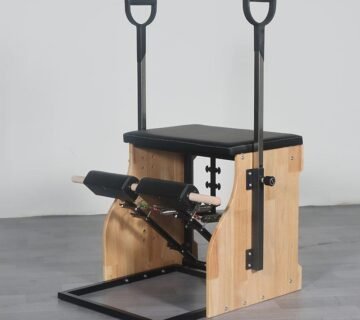
A Pilates Chair, traditionally known as the Wunda Chair, is a compact piece of Pilates apparatus featuring a sturdy frame, a padded seat, and one or two pedals connected to adjustable springs.
Although its design looks relatively simple, the chair supports a wide range of movements performed in seated, standing, kneeling, and prone positions. Practitioners use their hands, feet, and body weight to control the pedal against spring resistance.
What Is the History Behind the Wunda Chair?
The Wunda Chair was developed by Joseph Pilates as part of his original Contrology equipment collection. Unlike larger apparatuses designed primarily for studio training, the chair was also intended to make Pilates exercises accessible in smaller living spaces.
Its compact, furniture-like design allowed it to serve a practical purpose while doubling as exercise equipment.
Over time, the Wunda Chair became an established part of classical Pilates training. Its small footprint and extensive exercise repertoire made it particularly useful for developing strength, coordination, and movement control.
Today, modern Pilates chairs retain the basic concept while incorporating improvements in materials, spring configurations, pedal mechanisms, and ergonomic design.
How Does the Spring-Loaded Pedal System Work?
The pedal and spring system is what makes Pilates chair training distinctive.
When a practitioner presses the pedal downward, the attached springs create resistance. Depending on the exercise, this resistance can challenge the legs, arms, shoulders, and core muscles.
Some chairs feature adjustable spring attachment positions, allowing instructors to change the resistance according to the exercise and practitioner’s ability.
One important detail is that spring resistance does not always become easier as the number of springs increases. The actual training difficulty depends on spring tension, attachment position, pedal mechanics, and the movement being performed.
This is why understanding the equipment and selecting appropriate resistance are essential parts of effective Pilates instruction.
What Are the Key Benefits of Pilates Chair Workouts?
The Pilates Chair may occupy less floor space than a Reformer, but it offers a surprisingly extensive range of training possibilities.
Its benefits come from combining spring resistance, controlled movement, balance demands, and whole-body coordination.
How Does the Pilates Chair Build Core Strength and Stability?
Core engagement is central to almost every Pilates Chair exercise.
When practitioners press the pedal, they must maintain pelvic alignment and stabilize the trunk rather than allowing the body to shift with the movement.
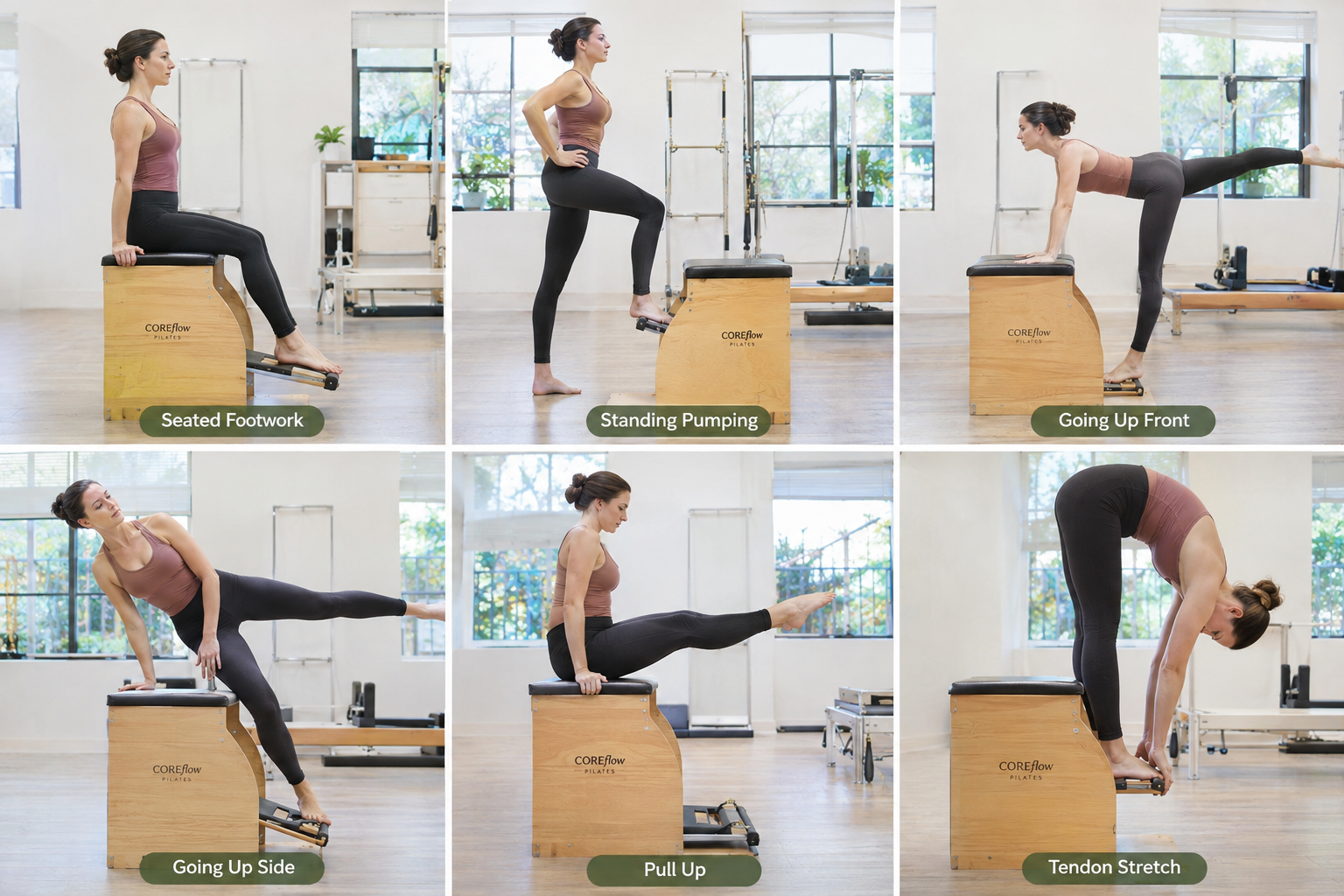
For example, during a standing pumping exercise, the supporting leg maintains balance while the abdominal and back muscles help stabilize the spine.
This creates an opportunity to develop core control during both stationary and dynamic movements.
Research published in the Journal of Bodywork and Movement Therapies specifically investigated the activation of four trunk muscles during three exercises performed on the Wunda Chair. Although this type of research does not establish that every chair exercise produces the same results, it highlights the importance of understanding muscle engagement in apparatus-based Pilates training.
Can Pilates Chair Exercises Improve Balance and Coordination?
Yes. Balance is one of the most distinctive challenges of chair-based Pilates.
Many exercises require practitioners to control the pedal while maintaining a stable position on a relatively small support surface.
Movements such as Going Up Front and Going Up Side challenge coordination between the upper and lower body.
For older adults, active individuals, and people developing better movement awareness, appropriately selected chair exercises can provide opportunities to practice controlled weight shifting and postural stability.
However, exercises involving single-leg support or elevated positions should be introduced gradually under qualified instruction.
How Does It Strengthen the Legs, Arms, and Entire Body?
The chair is not limited to abdominal training.
Depending on the exercise, practitioners can work on:
Legs and hips: Squats, standing pumps, and controlled step-up movements engage the lower body.
Arms and shoulders: Seated pumping and supported pushing exercises challenge upper-body strength.
Back muscles: Controlled extensions and pulling movements encourage coordinated back and shoulder engagement.
Core muscles: Plank variations and balance exercises require continuous trunk stabilization.
This versatility makes the Pilates Chair useful for both targeted muscle training and full-body movement sequences.
Can the Pilates Chair Improve Flexibility and Posture?
The chair can also complement flexibility and posture-focused training.
Controlled pedal movements allow practitioners to explore joint mobility and movement range while maintaining muscular engagement.
For example, exercises involving hip extension, spinal articulation, and controlled shoulder movement can help develop greater awareness of alignment.
Rather than forcing a deeper stretch, the goal is to combine mobility with strength and control.
This approach can be particularly valuable for clients who spend long hours sitting at a desk or want to improve their movement habits during everyday activities.
What Are the Best Pilates Chair Exercises to Try?
One of the biggest advantages of Pilates chair equipment is its extensive exercise repertoire. Instructors can select movements based on experience, strength, mobility, and individual training goals.
Here are four useful exercises to introduce into a chair-based program.
1. Seated Footwork and Standing Pumping
<Start with foundational movements that help practitioners understand how the pedal responds to spring resistance.
In seated footwork, practitioners press the pedal using their feet while maintaining an upright posture and controlled pelvic position.
Standing pumping introduces a greater balance challenge. The practitioner stands beside or in front of the chair, depending on the exercise variation, and controls the pedal through a measured pressing and returning motion.
These exercises are useful starting points for developing pedal awareness and lower-body coordination.
2. Going Up Front and Going Up Side
Going Up Front and Going Up Side are more challenging standing exercises.
They require practitioners to coordinate leg strength, core engagement, balance, and controlled pedal movement.
Going Up Front emphasizes forward-facing movement, while Going Up Side introduces a lateral challenge.
Both exercises can be valuable for experienced practitioners looking to develop greater control during single-leg and weight-bearing movements.
3. Pull Up and Tendon Stretch
Pull Up is an advanced exercise that challenges upper-body strength, trunk stabilization, and coordinated pedal control.
Tendon Stretch focuses on maintaining alignment while controlling movement through the ankles, knees, hips, and spine.
Both exercises require a good understanding of the equipment and should be introduced only when the practitioner has developed sufficient strength and control.
4. How Can You Progress from Beginner to Advanced Exercises?
A structured progression helps practitioners build confidence without introducing unnecessary difficulty.
| Training Level | Suggested Exercises | Main Focus |
| Beginner | Seated footwork, basic seated pumping | Pedal awareness and posture |
| Intermediate | Standing pumping, modified balance exercises | Lower-body strength and coordination |
| Advanced | Going Up Front, Going Up Side, Pull Up, Tendon Stretch | Strength, balance, and whole-body control |
The progression should depend on movement quality rather than simply the number of exercises a client can complete.
Instructors should also check spring attachment, pedal control, and chair stability before each session.
Pilates Chair vs. Reformer: What Makes the Chair Different?
Both the Pilates Chair and Reformer are important pieces of studio equipment, but they create different training experiences.
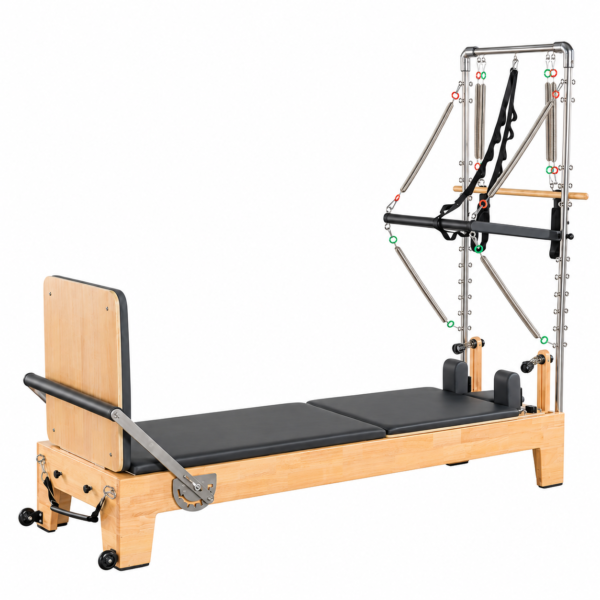
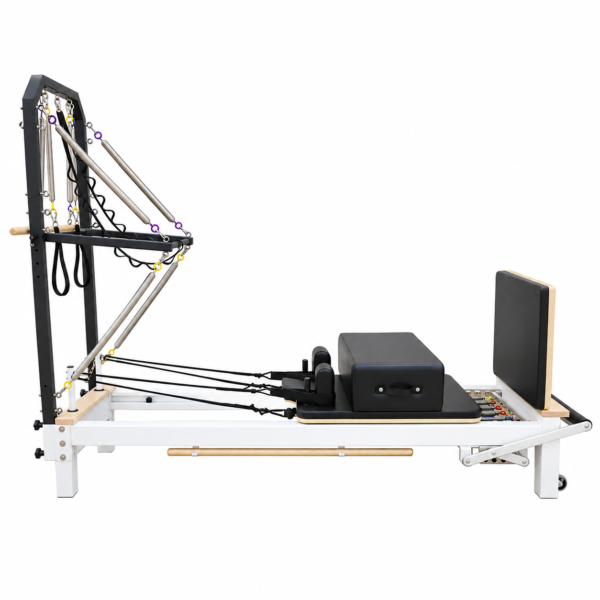
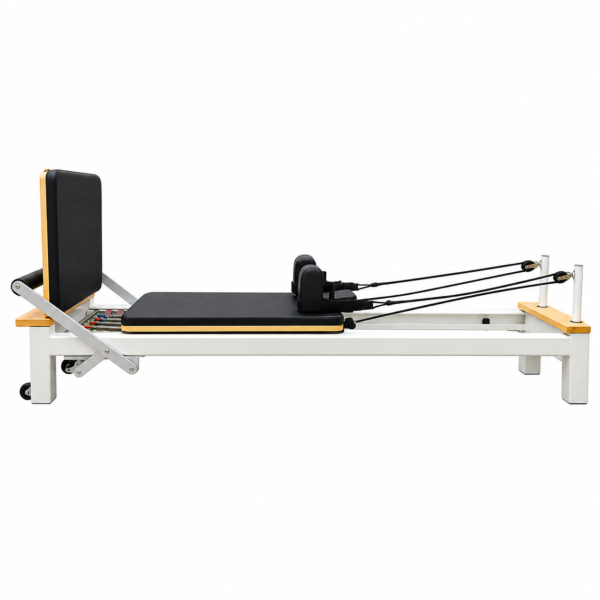
The Reformer uses a moving carriage, springs, ropes, and a footbar to support a broad range of exercises in lying, seated, kneeling, and standing positions.
The Pilates Chair uses a stationary frame and spring-loaded pedal. Its compact design encourages practitioners to work against resistance while managing their own body position and balance.
Here is a quick comparison:
| Característica | Silla Pilates | Pilates Reformer |
| Main Design | Stationary frame with spring-loaded pedal | Sliding carriage with spring resistance |
| Espacio necesario | Relatively compact | Requiere más espacio en el suelo |
| Training Focus | Balance, strength, coordination, and control | Full-body strength, mobility, and movement patterns |
| Resistance | Adjustable pedal springs | Adjustable carriage springs |
| Exercise Positions | Seated, standing, kneeling, and supported positions | Supine, prone, seated, kneeling, and standing |
| Uso en estudios de Pilates | Complementary training and targeted programs | Core equipment for a wide range of Pilates classes |
Which Pilates Equipment Is Better for Different Training Goals?
Neither machine is automatically better than the other.
A Reformer may be a practical choice for studios that focus on general Pilates classes, introductory programs, and a broad range of full-body exercises.
A Pilates Chair can be particularly valuable for studios looking to expand their exercise repertoire, introduce balance-focused training, and offer more challenging movement variations.
For many professional studios, the two machines work best together. The Reformer provides a versatile training foundation, while the chair introduces different resistance patterns and movement challenges.
How Can You Incorporate a Pilates Chair into Your Studio Practice?
Adding a Pilates Chair to a studio is not simply about purchasing another piece of equipment. It is about creating more possibilities for instructors and clients.
How Can Instructors Use the Chair to Expand Class Programs?
There are several practical ways to introduce chair training into an existing studio program.
- Add chair sessions to private training programs.
Instructors can use the chair to address individual training goals, such as balance, lower-body strength, and upper-body control.
- Introduce short chair sequences into existing classes.
A few appropriately selected chair exercises can add variety to a session without requiring a complete change in the class structure.
- Create specialized training programs.
Studios can develop intermediate and advanced chair sessions for experienced practitioners who want to explore more challenging Pilates movements.
- Make better use of limited studio space.
For smaller studios, a compact Pilates Chair can expand the available exercise options without requiring the floor area of another full-size Reformer.
What Should You Consider When Choosing a Pilates Chair?
Not all Pilates chairs are designed in exactly the same way. Studio owners should consider several factors before choosing their equipment.
Frame material: Solid oak, maple, and other suitable materials offer different appearances and construction characteristics.
Spring resistance: Check the available spring configurations and adjustment options to ensure they support your intended training programs.
Pedal design: Smooth, controlled pedal movement is important for consistent exercise performance.
Stability: The frame should provide a secure foundation for the movements it is designed to support.
Upholstery: Consider comfort, durability, and available color options.
Maintenance: Springs, attachment points, upholstery, and moving components should be accessible for regular inspection.
Customization: Studios and equipment distributors may benefit from customized colors, logos, materials, and configurations.
For studios looking for professional equipment, CoreFlow offers an oak Pilates Chair designed for studio training, with an adjustable spring system and customizable branding options.
As a Pilates equipment manufacturer, CoreFlow also supports different equipment configurations for businesses developing or expanding their Pilates spaces.
Explore our Pilates chair collection to learn more about available models and equipment options.
Conclusion
The power of the Pilates Chair lies in its ability to combine strength, balance, coordination, and controlled movement in a relatively compact piece of equipment.
From foundational seated footwork to advanced exercises such as Going Up Front and Pull Up, the chair provides instructors with a wide range of ways to challenge practitioners at different experience levels.
For studio owners, it can also be a practical addition to an existing equipment collection, helping expand class programs while making efficient use of available space.
Whether you are building a new Pilates studio or upgrading an established training space, the Pilates Chair is worth considering as part of a well-rounded equipment setup.
FAQs
Is the Pilates Chair Suitable for Beginners?
Yes. Beginners can use a Pilates Chair when exercises are selected according to their abilities and introduced under qualified instruction. Starting with seated footwork and basic pedal movements helps new practitioners understand resistance and develop control before progressing to more demanding exercises.
How Often Should You Use a Pilates Chair?
The frequency depends on individual fitness levels, training goals, and the rest of the exercise program. Many practitioners can incorporate chair exercises into their regular Pilates schedule, provided they allow sufficient recovery and maintain proper movement technique. A qualified instructor can help determine an appropriate routine.
What Is the Difference Between a Pilates Chair and a Wunda Chair?
The terms are often used interchangeably. Wunda Chair generally refers to the traditional chair design associated with Joseph Pilates, while Pilates Chair is a broader modern term that can describe different chair-style Pilates apparatuses. Some modern models also feature updated spring systems, pedal designs, and materials.
What Is a Combo Chair in Pilates?
A Combo Chair is a Pilates chair designed with a spring-loaded pedal system, often featuring adjustable resistance and configurations that support different exercise variations. The exact design and features vary between manufacturers, so it is important to check the specifications of each model.
Can a Pilates Chair Replace a Reformer?
Not completely. Both machines offer different exercise experiences. A Pilates Chair is useful for compact, balance-focused, and resistance-based training, while a Reformer supports a broader range of carriage-based movements. Many studios benefit from having both.
What Muscles Does a Pilates Chair Work?
Depending on the exercise, a Pilates Chair can engage the abdominal muscles, back, glutes, quadriceps, hamstrings, calves, shoulders, and arms. The exact muscle involvement varies with body position, spring resistance, and movement technique.


No comment