
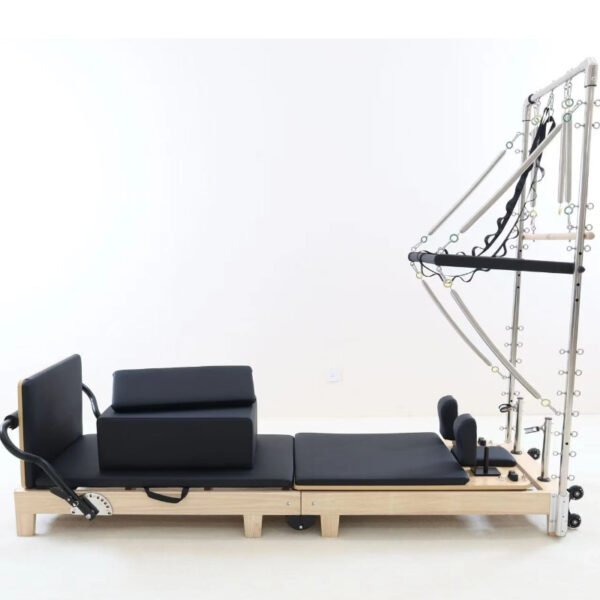






If you have spent time in a professional Pilates studio, you may have seen a large padded table surrounded by a metal frame, springs, bars, and straps. This apparatus is commonly called a Pilates trapeze table, Pilates Cadillac, or simply a Cadillac.
Unlike a Pilates reformer, the bed of a trapeze table remains stationary. Instead, the practitioner works with adjustable springs, bars, straps, and the overhead trapeze to create assistance, resistance, or support. This makes the equipment useful across a surprisingly wide range of training situations—from introductory movement and mobility work to advanced Pilates exercises.
For studios, physical therapy practices, and experienced home users, understanding how a trapeze table works can make it easier to decide whether this equipment belongs in a training space.
This guide explains the structure, benefits, exercises, applications, and buying considerations of a trapeze table Pilates setup, while also comparing it with a reformer and a Pilates reformer with tower.
What Is a Pilates Trapeze Table and How Does It Work?
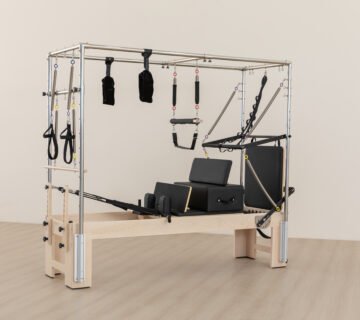
A Pilates trapeze table is a padded, stationary exercise table surrounded by a frame that supports springs, bars, straps, and a trapeze bar. The frame provides multiple attachment points, allowing instructors to change the direction and resistance of an exercise.
The equipment is also widely known as a cadillac trapeze table or cadillac pilates table. Although designs vary between manufacturers, a full Cadillac typically combines a stable table with an overhead frame and several accessories.
One reason the apparatus is so versatile is that the springs can either assist movement or make an exercise more demanding. This allows the same equipment to be adapted to different body sizes, movement abilities, and training goals.
Is a Pilates Trapeze Table the Same as a Cadillac?
In most Pilates settings, yes. “Trapeze table” and “Cadillac” generally refer to the same type of apparatus. The name Pilates Cadillac is especially common in professional studios, while “trapeze table” emphasizes the overhead trapeze component. Some manufacturers use slightly different configurations, so it is worth checking the included accessories before purchasing.
What Are the Main Components of a Trapeze Table?
A typical Pilates trapeze includes:
A padded, stationary table
Four vertical frame posts
An overhead frame or canopy
Adjustable springs
Push-through bar
Roll-down bar
Trapeze bar
Leg and arm springs
Straps, loops, and safety attachments
The frame is particularly important because it determines where springs and bars can be positioned. Multiple attachment points give instructors more options for modifying exercises.
How Do Springs, Bars, Straps, and the Trapeze Work Together?
Springs provide adjustable resistance or assistance, while bars and straps guide the body through controlled movement. The trapeze can support suspension and advanced exercises. Changing spring position, tension, or attachment point can significantly alter how an exercise feels.
What Are the Benefits of Pilates Trapeze Table Exercises?
The main advantage of trapeze Pilates is versatility. Instead of providing only resistance, the equipment can also support movement and help a practitioner explore positions that may be difficult to perform on a mat.
Research on Pilates should still be interpreted carefully because results vary by population, program, and exercise method. A 2023 umbrella review of 27 systematic reviews found evidence of potential benefits across several health outcomes, but also noted that the certainty of evidence ranged from very low to moderate.
For this reason, it is more accurate to view the trapeze table as a versatile training tool rather than a guaranteed solution for a particular health condition.
Can a Trapeze Table Improve Strength and Core Stability?
Many trapeze table exercises require controlled movement of the trunk while the arms or legs work against spring resistance. For example, push-through movements, leg springs, and supported teaser variations can challenge abdominal and hip musculature.
A systematic review of 11 randomized studies found that Pilates can improve strength compared with inactivity, although it was not clearly superior to other forms of exercise for strength, balance, or flexibility.
The stable table also gives practitioners a consistent base, which can make it easier to focus on movement control.
Can It Improve Flexibility, Mobility, and Posture?
The combination of spring assistance and controlled movement can be useful when working on spinal articulation, hip mobility, shoulder movement, and flexibility.
A 2024 systematic review examined 13 studies involving 783 participants and found evidence suggesting Pilates may help address certain postural problems, although the authors also emphasized differences between studies and the need for further research.
In practical studio sessions, instructors can use springs to make a movement more accessible before gradually reducing assistance as control improves.
Why Is the Trapeze Table Useful for Rehabilitation?
The stationary table provides a stable surface, while the springs can provide carefully controlled assistance. This combination can be useful when a client needs to practice movement without immediately dealing with the instability of a moving carriage.
For example, an instructor working with a client returning to exercise after an injury might begin with supported leg or arm movements, then gradually increase range of motion or resistance as appropriate.
For rehabilitation clients, exercise selection and progression should be based on the individual’s condition and professional assessment. A trapeze table should complement—not replace—appropriate clinical guidance.
What Pilates Trapeze Table Exercises Can You Do?
One of the defining characteristics of a Pilates trapeze table is its exercise range. A session can start with relatively simple supported movements and progress toward highly demanding suspension work.
The exact exercise selection should depend on the practitioner’s experience, instructor supervision, and physical condition.
What Are the Best Beginner Trapeze Table Exercises?
Beginners can start with controlled movements such as:
Roll-down variations
Basic leg spring exercises
Arm spring exercises
Supported spinal articulation
Gentle push-through movement
For example, a beginner may use the roll-down bar with spring assistance to practice segmental spinal movement while keeping the exercise relatively controlled.
The objective is not simply to make an exercise easier. Proper spring setup can help the practitioner understand alignment, breathing, and movement control.
Which Exercises Are Suitable for Intermediate Practitioners?
Once basic movement patterns are familiar, practitioners may progress to exercises such as:
Teaser variations
Mermaid
Pendulum movements
More challenging push-through exercises
Advanced leg and arm spring sequences
The Pilates Cadillac is particularly useful here because spring resistance can be adjusted progressively rather than forcing the practitioner to move immediately to a more difficult exercise.
What Advanced Pilates Exercises Can You Perform on a Trapeze Table?
Advanced trapeze Pilates may include hanging exercises, backbends, inversions, and other suspension-based movements.
These exercises require substantially more strength, coordination, shoulder stability, grip control, and body awareness than beginner movements. They should generally be taught by an appropriately trained instructor rather than attempted independently from a video.
The frame and safety components are especially important for advanced work because the user may place substantial body weight through the apparatus.
Who Should Use a Pilates Trapeze Table and How Does It Compare With a Reformer?
A trapeze table can suit a broad range of users, but the best equipment depends on the training environment.
For a Pilates studio, the Cadillac may be valuable when instructors work with beginners, private clients, mobility-focused sessions, or advanced practitioners. For rehabilitation-focused facilities, the stable platform and adjustable spring system can provide additional exercise options.
If your studio needs both a moving carriage and spring-based tower exercises, a reformer may offer a more space-efficient solution. CoreFlow also provides Pilates reformer equipment for studios looking to build a broader Pilates equipment setup.
Is a Trapeze Table Suitable for Beginners?
Yes, with appropriate instruction. The fixed table can provide a stable base, while springs may assist certain movements. Beginners should generally learn the basic setup and spring positions before progressing to more demanding exercises.
Is a Trapeze Table Good for Pilates Rehabilitation?
It can be useful in rehabilitation-oriented Pilates because the fixed table provides support and the springs can be configured to assist movement. However, rehabilitation programs should be individualized and supervised by appropriately qualified professionals when medical conditions or injuries are involved.
What Is the Difference Between a Trapeze Table and a Pilates Reformer?
| Feature | Pilates Trapeze Table | Pilates Reformer |
| Main platform | Fixed padded table | Moving carriage |
| Resistance | Springs attached to frame | Springs connected to carriage |
| Overhead work | Extensive | Limited unless equipped with tower |
| Suspension exercises | Yes | Generally limited |
| Rehabilitation use | Often useful | Also widely used |
| Advanced repertoire | Broad | Broad, but different |
A Pilates reformer with tower can bridge part of this gap by combining a moving carriage with an upright tower and springs. However, it does not necessarily provide the same overhead space or full trapeze configuration as a dedicated Cadillac.
How Can You Choose the Right Pilates Trapeze Table?
Choosing a commercial Pilates trapeze table requires more than comparing the appearance or number of accessories. Studios should consider how frequently the equipment will be used, who will use it, and what exercises instructors plan to teach.
What Features Should You Look for in a Commercial Trapeze Table?
Look for a rigid frame, durable upholstery, reliable springs, secure attachment points, smooth-adjusting bars, and well-designed safety components. Commercial equipment should also be suitable for repeated daily use rather than occasional home workouts.
How Important Are Frame Stability, Spring Resistance, and Adjustability?
They are fundamental. The frame needs to remain stable during movement, while spring resistance should be predictable and adjustable. Multiple attachment positions allow instructors to modify exercises for different users and progression levels.
What Should Pilates Studios Consider Before Buying a Trapeze Table?
Measure the available floor and ceiling space first. A full Cadillac is substantially larger than many home Pilates machines, and overhead clearance matters. Studios should also consider upholstery durability, maintenance, warranty support, replacement parts, and whether OEM/ODM customization is available.
At CoreFlow, we manufacture Pilates equipment for professional studios and distributors, with options designed around different studio layouts and equipment requirements. If you are comparing configurations, you can explore our Cadillac Pilates equipment category or review our Pilates reformer range to determine which setup better fits your business.
Conclusion
A Pilates trapeze table is much more than a padded table with a metal frame. Its combination of a stable platform, adjustable springs, bars, straps, and overhead trapeze creates an adaptable training environment that can support beginners, experienced practitioners, and appropriately supervised rehabilitation-focused sessions.
Its main distinction from a reformer is the stationary table and extensive overhead framework. While a reformer emphasizes movement through a carriage, Cadillac Pilates equipment creates opportunities for supported, resisted, and suspended movement around a fixed base.
For studios, the right choice ultimately depends on the clients you serve, the exercises you teach, available space, and expected daily usage. A well-designed commercial trapeze table can become a useful part of a broader Pilates equipment system when its features match those practical needs.
FAQs
What is a Pilates trapeze table used for?
A Pilates trapeze table is used for strength, mobility, flexibility, movement control, supported Pilates exercises, and advanced suspension work. Its adjustable springs can provide either assistance or resistance depending on the exercise and setup.
Is a Pilates trapeze table suitable for beginners?
Yes. Many beginner exercises can be modified using the stable table and spring assistance. However, beginners should learn the equipment from a qualified instructor, particularly before using the trapeze, push-through bar, or advanced spring configurations.
What is the difference between a Pilates trapeze table and a reformer?
A trapeze table has a fixed padded bed surrounded by an overhead frame. A reformer has a moving carriage that travels along a frame. A reformer with tower adds vertical spring attachments, but a full Cadillac generally offers more overhead and suspension-based exercise options.
Is a Pilates Cadillac the same as a trapeze table?
In most Pilates terminology, yes. “Cadillac,” “trapeze table,” and “Cadillac trapeze table” commonly describe the same general apparatus, although the exact accessories and frame configuration can vary between manufacturers.
Is a Cadillac better than a reformer?
Neither is universally better. A Cadillac may be preferable for studios emphasizing rehabilitation, mobility, supported exercises, and advanced suspension work. A reformer may be more appropriate when carriage-based training is the primary focus.
How much space does a Pilates trapeze table need?
Space requirements vary by model. In addition to the footprint of the table, allow sufficient clearance around the equipment and above the frame for overhead exercises. Always check the manufacturer’s exact dimensions and recommended installation clearance before purchasing.
Can a trapeze table be used for rehabilitation?
It can be incorporated into rehabilitation-oriented Pilates programs because its fixed surface and adjustable springs can provide support and controlled resistance. However, people recovering from an injury or managing a medical condition should receive individualized exercise guidance from an appropriately qualified professional.
Is a Pilates trapeze table worth it for a commercial studio?
For studios offering private sessions, rehabilitation-oriented Pilates, mobility training, or a wide range of apparatus-based exercises, a trapeze table can add considerable programming flexibility. The decision should be based on client demand, instructor expertise, available space, and expected equipment utilization.

No comment