
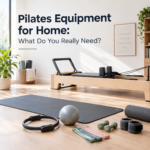






Pilates does not require a room full of machines. For many people, a mat and a few simple props are enough to build a consistent routine at home. Others may prefer a Pilates reformer for home use because it provides adjustable spring resistance and a wider range of equipment-based exercises.
That difference is important when choosing Pilates equipment for home workouts. The right setup depends on your experience, training goals, available space, storage needs, and how often you expect to exercise.
Research also suggests that consistency matters more than simply owning more equipment. A systematic review of nine randomized controlled trials found that Pilates performed two to three times per week for five to twelve weeks improved abdominal muscular endurance compared with no exercise, with an average difference of 9.53%. The review included both mat- and apparatus-based Pilates.
So, instead of asking which piece of equipment is universally “best,” it is more useful to ask: Which home Pilates equipment fits the way you actually want to train?
What Pilates Equipment Do You Need for Home Workouts?
The amount of Pilates equipment you need depends largely on the type of Pilates you plan to practice.
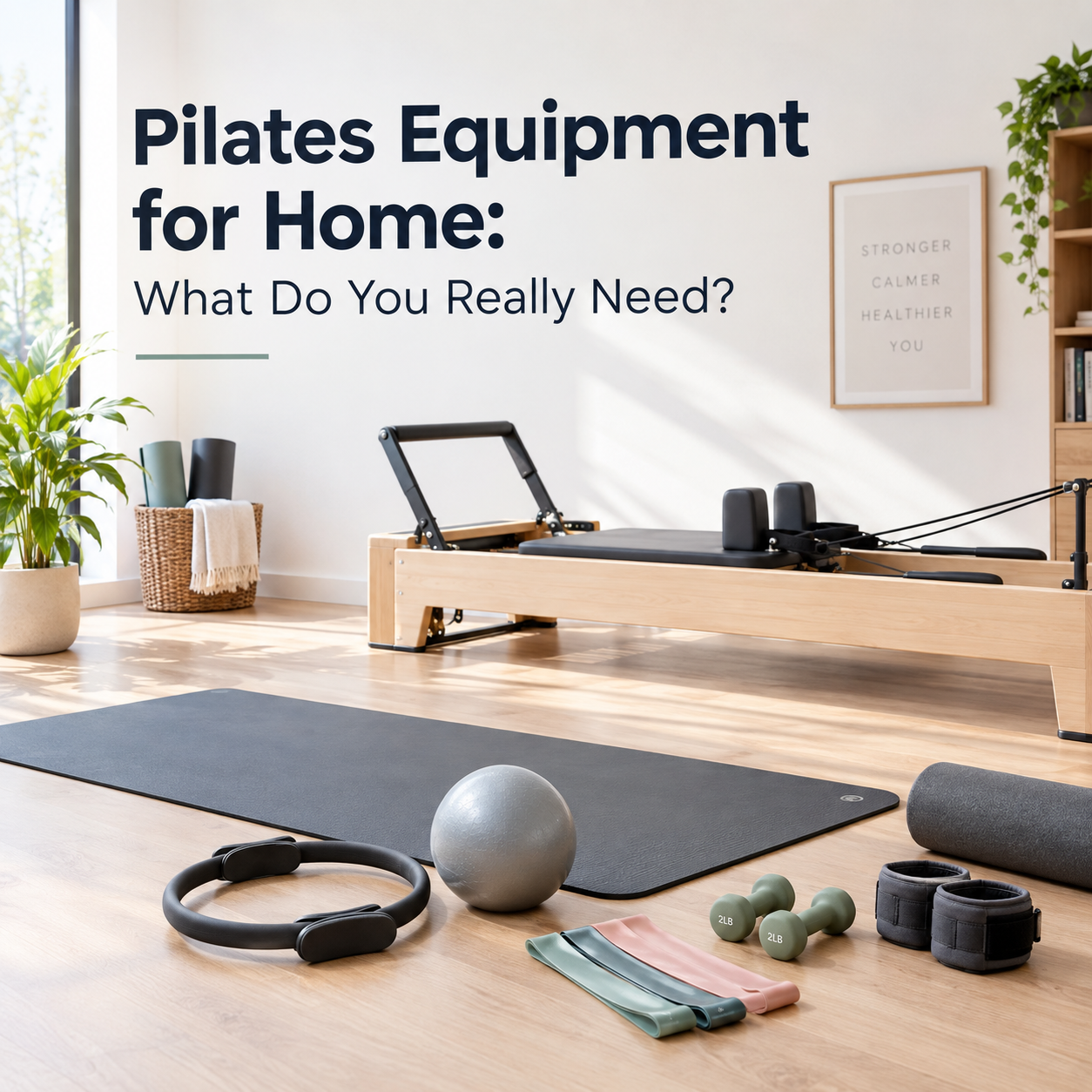
If you are new to Pilates, a mat can support a wide range of exercises without requiring a large investment or dedicated room. Small props such as a Pilates ring, resistance bands, or a Pilates ball can then be added to introduce resistance, support, or additional movement variations.
This is one reason at home Pilates equipment can be much simpler than a commercial studio setup.
A beginner working out in a bedroom or home office may only need enough floor space for a mat. Someone who already attends Reformer classes may have a different goal and may want to reproduce more of that equipment-based training environment at home.
A systematic review of 16 studies involving healthy people found evidence supporting Pilates for improving flexibility and dynamic balance, with moderate evidence for improving muscular endurance. However, the authors also noted that the methodological quality of the studies varied, so the findings should not be interpreted as proof that Pilates is superior to every other form of exercise.
For most people, a practical approach is to start with the equipment that supports their current routine and add larger apparatus only when there is a clear reason to do so.
What Is the Best Pilates Equipment for Home?
There is no single piece of Pilates equipment that works best for every user.
A useful way to think about Pilates home equipment is to divide it into three groups: essential equipment, small accessories, and larger Pilates apparatus.
Pilates Mat
A Pilates mat is usually the simplest starting point for home workouts.
Mat Pilates uses bodyweight and controlled movement, so you can perform many exercises without a machine. A supportive mat provides cushioning and grip for exercises performed on the back, knees, hands, or sides of the body.
For beginners, the mat also removes one of the biggest barriers to starting Pilates: setup.
You can leave it in a home office, bedroom, or living room and begin a workout within minutes. If your main goal is to establish a consistent routine, that simplicity can be more valuable than having a large collection of equipment.
Pilates Reformer
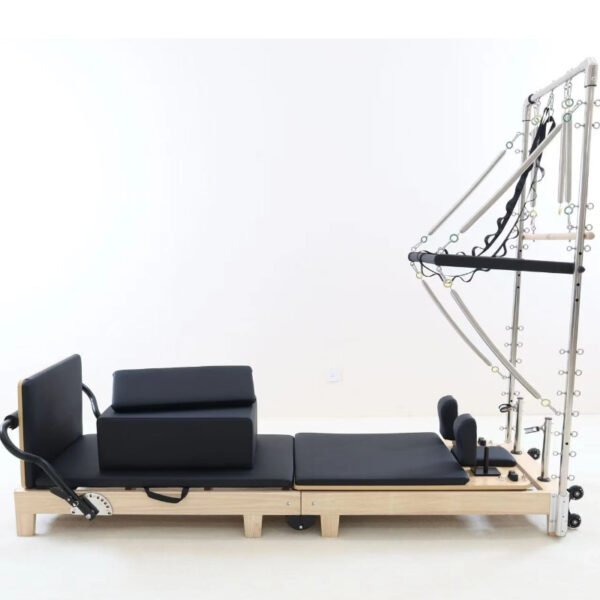
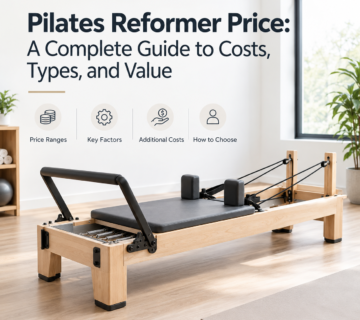
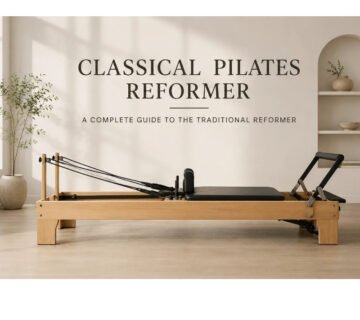
A Pilates reformer is a larger piece of apparatus designed around a moving carriage, springs, footbar, straps or ropes, and other supporting components.
The spring system provides adjustable resistance while the carriage creates a moving surface that challenges control and stability. Depending on the configuration, reformers can support exercises for the legs, arms, core, hips, and full body.
A Pilates reformer is particularly relevant for people who already enjoy Reformer classes or want more resistance and exercise variety than mat Pilates provides.
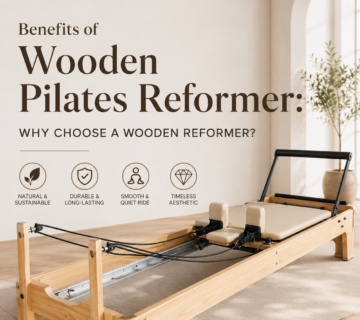
For home users, there are several configurations to consider, including wooden reformers, aluminum reformers, classical reformers, foldable reformers, and reformers equipped with towers.
The important point is not simply choosing the largest machine. The reformer needs to fit both your training requirements and your room.
Pilates Ring or Magic Circle
The Pilates ring, also known as a Magic Circle, is a compact resistance prop.
It can be placed between the thighs, knees, ankles, or hands to create additional tension during selected movements. Because it takes up very little storage space, it is easy to add to a beginner home setup.
A ring can also make familiar mat exercises feel different without requiring a large increase in equipment or workout space.
Resistance Bands
Resistance bands are another practical form of Pilates equipment for home use.
They can provide additional resistance for upper- and lower-body exercises and are easy to store in a drawer or small equipment basket.
Bands can also be useful when you want to combine Pilates-style movement with general strength or mobility work.
Pilates Ball
A small Pilates ball can be used for support, positioning, or added instability.
For example, placing a ball between the thighs during selected exercises changes the movement challenge, while positioning it beneath part of the body can alter support.
Peloton’s guide to at-home Pilates equipment lists the Pilates ball, ring, sliders, resistance bands, and ankle weights among optional props that can add variety to a mat-based routine.
Ankle Weights and Other Small Accessories
Ankle weights, sliders, blocks, grip socks, straps, and foam rollers are optional rather than essential.
They can be useful once you have established a routine and understand which movements you want to make more challenging or accessible.
For beginners, there is little reason to purchase every accessory at once. Start with the pieces you are most likely to use and expand your setup gradually.
| Pilates Equipment | Best For | Space Needed | Main Purpose |
| Pilates mat | Beginners and mat Pilates | Very low | Floor-based exercises |
| Pilates ring | Resistance and control | Very low | Adds light resistance |
| Resistance bands | Strength and mobility | Very low | Adjustable resistance |
| Pilates ball | Stability and exercise variety | Very low | Support or instability |
| Pilates chair | Strength and balance | Low–medium | Apparatus-based training |
| Pilates reformer | Regular practitioners | Medium–high | Spring-based resistance training |
Should You Buy a Pilates Reformer for Home?
A Pilates reformer for home is a significantly larger purchase than a mat or small prop, so it is worth thinking about your expected usage before buying one.
If you already attend Reformer Pilates classes and enjoy equipment-based training, owning a reformer can make it easier to maintain that type of workout without traveling to a studio.
A reformer may also appeal to users who want adjustable resistance and more exercise options than they can get from mat Pilates alone.
However, owning a reformer is not a requirement for practicing Pilates effectively. Research has found positive outcomes from both mat and apparatus-based Pilates, while other research comparing Pilates with different exercise approaches has not consistently found Pilates to be superior across strength, balance, and flexibility outcomes.
That makes the buying decision more practical than promotional: a reformer is valuable when its features match the way you want to train and you will use it consistently.
When Is a Home Pilates Reformer Worth It?
Consider a home reformer if several of the following describe your situation:
You already enjoy Reformer Pilates.
You expect to train several times per week.
You want adjustable resistance.
You have sufficient space for the machine and movement around it.
You prefer equipment-based workouts over primarily mat-based sessions.
You want to build a dedicated home Pilates area.
For example, someone who attends two Reformer classes every week may find a home reformer useful because equipment-based Pilates is already part of their routine.
By contrast, someone who has never tried Pilates may prefer to begin with a mat and a few accessories. After several weeks of regular practice, they will have a better idea of whether a larger machine is worth adding.
What Should You Look for in a Home Reformer?
When choosing a Pilates reformer for home use, consider more than the appearance or initial price.
Frame construction: A stable frame is important for controlled movement and regular use.
Carriage movement: The carriage should move smoothly and predictably along its track.
Spring resistance: Look at the available spring options and how easily resistance can be changed.
Footbar adjustment: Different exercises and body sizes may require different footbar positions.
Padding: The carriage and shoulder areas should provide appropriate support during longer sessions.
Machine dimensions: Measure the available room before purchasing. Remember that the usable exercise area is larger than the machine itself.
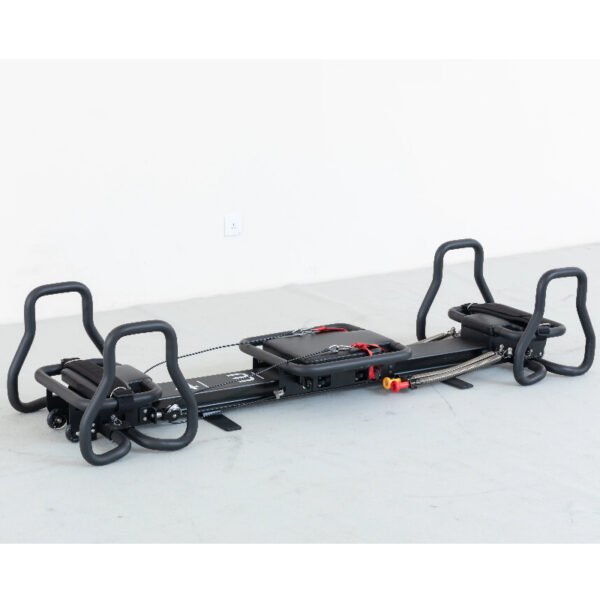
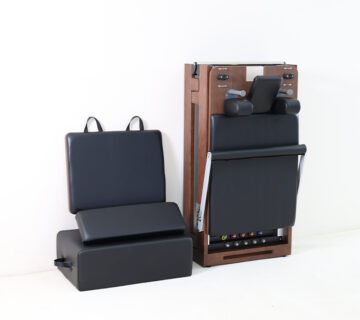
Storage: If your Pilates space also serves as a bedroom, office, or living area, a foldable design may be particularly useful.
Configuration: A basic reformer may be sufficient for some users, while a tower reformer can provide additional exercise possibilities.
CoreFlow manufactures several types of Pilates reformers, including wooden, aluminum, classical, foldable, and tower configurations. This gives home users different options depending on how they plan to use the equipment.
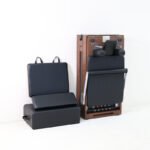
For example, CoreFlow’s walnut wood folding reformer measures approximately 2,420 × 680 × 270 mm in its operating configuration and 1,200 × 655 × 370 mm when folded. The model uses a stainless steel track, German imported piano wire springs, microfiber leather upholstery, and EVA cushioning.
Those numbers illustrate an important consideration for home buyers: always check both the operating dimensions and the storage dimensions.
How Do You Choose Pilates Equipment for Your Home?
When comparing Pilates equipment, start with your actual training environment rather than a generic equipment checklist.
Consider Your Experience Level
Beginners can start with mat-based Pilates and basic props.
If you already understand Reformer exercises, spring changes, footbar positioning, and basic equipment setup, a Pilates reformer for home may be a more natural choice.
If you are new to reformer training, learning the basic movements and equipment adjustments from a qualified Pilates instructor can help you use the machine appropriately.
Measure Your Workout and Storage Space
Space is one of the most overlooked factors when choosing home Pilates equipment.
A machine may technically fit in your room but still leave too little space to move comfortably around it.
Before purchasing a reformer, measure:
The full length of the machine.
The width of the machine.
The available clearance around it.
The space required for straps and moving components.
The storage footprint if the machine folds.
This is especially important in apartments and multipurpose rooms.
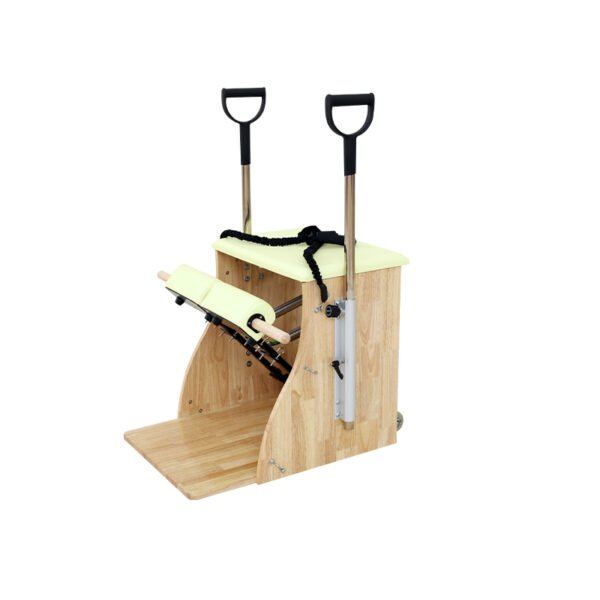
A compact Pilates chair can be another option for users who want apparatus-based Pilates without the footprint of a full-length reformer.
For example, CoreFlow’s C09-11 Oak Pilates Chair measures 790 × 750 × 610 mm and has a listed net weight of 29 kg. Its compact footprint can make it easier to incorporate into a smaller home Pilates area.
Match the Equipment to Your Training Goals
Your goals should determine your equipment.
If you mainly want mat-based workouts, a mat and a few props may be enough.
If you want adjustable resistance and more equipment-based exercises, a reformer is worth considering.
If you want a compact apparatus for strength, balance, and controlled movement, a Pilates chair may be appropriate.
For users with a dedicated room and more advanced training needs, a reformer with a tower, Cadillac, or additional apparatus can create a more complete Pilates environment.
Consider Your Budget and Frequency of Use
A useful way to evaluate Pilates equipment is to consider how often you expect to use it, rather than looking only at the purchase price.
A small accessory may be sufficient for someone who practices Pilates once or twice a week. Someone who trains regularly may get more practical value from a dedicated reformer.
Think about your expected usage over the next year or two.
If a piece of equipment is difficult to store, complicated to set up, or inconvenient to use, even a technically capable machine may not become part of your regular routine.
How Can Beginners Build a Home Pilates Setup?
You do not need to recreate a commercial Pilates studio at home.
A gradual approach is often more practical.
Start With the Essential Equipment
Start with a Pilates mat and create a dedicated space where you can comfortably perform floor exercises.
Once you are comfortable with basic movements, add one or two small props.
A Pilates ring can add resistance, while resistance bands can provide additional exercise variations. A small Pilates ball can be useful for selected stability and positioning exercises.
This creates a practical home Pilates equipment setup without requiring much storage space.
Research provides another useful perspective here. In one randomized controlled study, participants completed one-hour Pilates sessions twice per week for 12 weeks, with improvements reported in several physical fitness measures including abdominal endurance and flexibility.
The takeaway is not that everyone must follow exactly the same schedule. Rather, it demonstrates why establishing a repeatable routine is more important than buying every available piece of Pilates equipment.
Add Equipment as Your Pilates Practice Progresses
After several weeks or months, your training preferences will become clearer.
You may discover that mat Pilates provides everything you need.
Or you may want more resistance and a wider range of movements, making a Pilates reformer the next logical addition.
For small homes, a foldable Pilates reformer can help balance workout capability with storage requirements. For a dedicated Pilates room, you may prefer a full-size reformer or a reformer with tower.
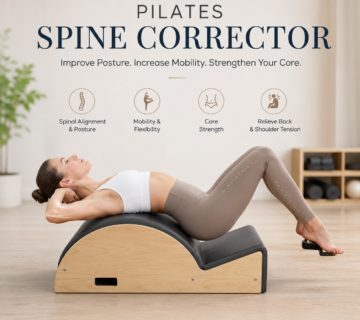
More advanced home Pilates equipment can also include a Pilates chair, Cadillac, Ladder Barrel, Spine Corrector, or Wall Unit.
CoreFlow’s range includes reformers, tower reformers, Cadillac systems, Pilates chairs, Ladder Barrels, Wall Units, and other Pilates apparatus, allowing a home setup to grow as training requirements change.
How Much Space Do You Need for Pilates Equipment at Home?
The answer depends on the type of equipment.
A mat requires only enough clear floor area for the exercises you plan to perform. Small props need almost no dedicated storage.
A reformer requires considerably more planning because the machine has a defined operating footprint and moving components.
| Equipment Type | Space Planning Consideration | Suitable Home Situation |
| Pilates mat | Clear floor area | Bedroom, office, living room |
| Small props | Drawer or small storage area | Almost any home |
| Pilates chair | Compact floor footprint | Small dedicated workout area |
| Foldable reformer | Operating + folded dimensions | Multipurpose room |
| Full-size reformer | Machine + movement clearance | Dedicated workout room |
| Reformer with tower | Larger vertical and floor setup | Dedicated Pilates space |
For a multipurpose room, the folded dimensions can be particularly important. A reformer that remains open all the time may not be practical if the same room is used for work, guests, or everyday activities.
Which Pilates Equipment Is Best for Different Home Users?
Different users can reasonably choose different Pilates equipment.
For a Pilates Beginner
Start with a mat and perhaps one or two small props.
This provides enough equipment to learn basic movement patterns without committing to a large machine.
For Someone With Limited Space
Prioritize compact equipment.
A mat, ring, resistance bands, and small Pilates ball require very little storage. If you eventually want a reformer, consider a foldable model and carefully check both its open and folded dimensions.
For a Regular Reformer User
A home Pilates reformer may make more sense.
If you already understand reformer exercises and expect to use the machine frequently, investing in a suitable home model can create a more consistent equipment-based training environment.
For a Dedicated Home Pilates Room
You have more flexibility.
A full-size reformer can serve as the main piece of equipment, while a tower, Pilates chair, Cadillac, Ladder Barrel, or other apparatus can expand the range of exercises available.
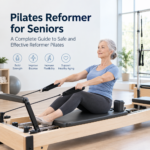
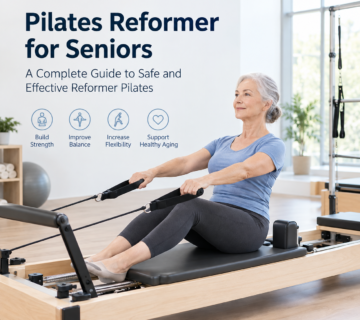
For Older Adults
Equipment selection should focus on stability, accessibility, and appropriate supervision rather than simply adding resistance.
A systematic review and meta-analysis involving 39 randomized studies of adults aged 60 and older found Pilates was associated with improvements in balance, strength, flexibility, and functional performance compared with control groups. However, the certainty of evidence was low for some outcomes, so these findings should not be interpreted as a guarantee for every individual.
For anyone with significant mobility limitations, an existing injury, or other health concerns, appropriate professional guidance is more important than the specific brand or type of equipment.
Home Pilates Equipment: A Practical Buying Checklist
Before purchasing Pilates equipment for home, ask yourself these questions:
- What type of Pilates do I actually want to practice?
Mat Pilates and Reformer Pilates require different equipment. - How often will I use it?
Regular use can justify a larger investment more easily than occasional use. - How much space do I have?
Measure before purchasing, especially for reformers. - Do I need the equipment to fold or move?
This can be important in apartments and multipurpose rooms. - What level of resistance do I need?
A reformer’s spring system should match your current level while providing room for progression. - Will I share the equipment with another person?
Adjustability becomes more important when users have different heights or training levels. - Can I maintain and service the equipment?
For larger machines, check the availability of replacement components and after-sales support.
This checklist can help you avoid buying Pilates equipment simply because it looks impressive online.
Conclusion
The best Pilates equipment for home is the equipment that fits your training, your room, and your routine.
For beginners, a Pilates mat is often enough to start. A Pilates ring, resistance band, or small Pilates ball can then add variety without taking up much space.
For regular practitioners, a Pilates reformer for home can provide adjustable spring resistance and a broader range of equipment-based exercises. A foldable Pilates reformer can be particularly useful when a room needs to serve multiple purposes, while a reformer with a tower can offer additional training options.
Research suggests that consistent Pilates practice can support outcomes such as muscular endurance, flexibility, and balance in certain populations, but current evidence does not establish Pilates as universally superior to other forms of exercise.
That is why choosing Pilates equipment should start with your needs rather than the equipment itself.
Start with what you will use consistently. Measure your space before purchasing larger apparatus. Add equipment as your practice develops.
Whether your ideal setup is a simple mat and resistance band or a complete home Pilates studio with a reformer, tower, and chair, the goal is the same: create a setup that makes regular Pilates practice practical.
FAQs
Can you do Pilates at home without equipment?
Yes. You can perform many Pilates exercises using only your bodyweight and a comfortable floor surface. A Pilates mat is useful for cushioning and grip, but small props are optional.
If you are searching for Pilates at home equipment as a beginner, you do not need to purchase a reformer immediately. A mat, Pilates ring, resistance band, or small ball can provide plenty of variety for a basic home routine.
What Pilates equipment should a beginner buy first?
A Pilates mat is usually the most practical starting point.
After you become comfortable with basic exercises, you can add a Pilates ring, resistance bands, or a small Pilates ball according to your training needs.
If you already have experience with Reformer Pilates, have sufficient space, and expect to train regularly, a Pilates reformer for home can be considered as your primary piece of equipment.
Is a Pilates reformer worth buying for home use?
A Pilates reformer can be worthwhile if you enjoy equipment-based Pilates, plan to use it regularly, and have enough room for both the machine and safe movement around it.
Before purchasing, compare frame construction, carriage movement, spring resistance, footbar adjustment, dimensions, storage options, and after-sales support.
For smaller homes, a foldable reformer can make the equipment easier to store. For a dedicated Pilates room, a full-size reformer or reformer with tower may provide more training options.
What is the difference between home Pilates equipment and studio Pilates equipment?
The main difference is usually the intended environment and configuration rather than the basic principles of Pilates.
Home Pilates equipment often places greater emphasis on compact dimensions, storage, portability, and ease of setup. Studio equipment may prioritize heavy daily use, multiple-user adjustability, and a broader range of apparatus.
The right choice depends on how the equipment will actually be used.
How often should you use Pilates equipment at home?
There is no single frequency that applies to everyone. Research has used different Pilates schedules, including sessions two to three times per week. One systematic review found that Pilates performed two to three times weekly for five to twelve weeks was associated with improved abdominal muscular endurance compared with no exercise.
For beginners, a manageable schedule that can be maintained consistently is generally more practical than starting with an overly demanding routine.

No comment