






If you spend hours at a desk, drive frequently, or simply feel stiff through your upper back and shoulders, you may have come across a piece of Pilates equipment called a Pilates Spine Corrector.
At first glance, a spine corrector looks simple: a curved barrel-like surface combined with a raised step or platform. But its shape gives it an important role in Pilates. Instead of lying completely flat on the floor, you can use the curved surface to support the spine while performing controlled extension, flexion, rotation, stretching, balance, and core exercises.
A spine corrector Pilates workout can therefore feel quite different from traditional mat Pilates. The equipment changes your body’s position and provides feedback, which can make certain movements easier to understand while also creating new challenges for the core and postural muscles.
But what exactly is a Pilates Spine Corrector? Is it the same as a Pilates Arc or small barrel? And is it useful for beginners?
This guide explains how a spine corrector works, its potential benefits, common exercises, and what to consider when choosing one for home or professional Pilates use.
What Is a Pilates Spine Corrector?
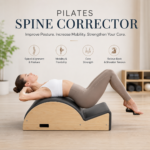
A Pilates Spine Corrector is a compact Pilates apparatus with a curved surface designed to support and challenge the body during controlled movement.
The curved section is generally positioned underneath the torso, while the raised step provides a platform for the feet or hands during different exercises. This configuration allows practitioners to work with the natural curves of the spine rather than always exercising on a flat surface.
Unlike a reformer, a spine corrector does not use springs, ropes, or a moving carriage. Its resistance comes primarily from your own body weight, leverage, balance, and muscular control.
The apparatus is particularly useful for exercises involving spinal articulation, chest opening, abdominal control, back-body strengthening, and mobility.
What Does a Pilates Spine Corrector Look Like?
A traditional spine corrector usually consists of:
- A curved barrel or arc-shaped section
- A raised step or platform
- A supportive frame or solid body
- Padding or upholstery for comfort
- A stable base to prevent unwanted movement
Many professional models are made from hardwood such as maple or oak, while lighter versions may use foam or composite materials.
The exact dimensions and curve vary between manufacturers, so two spine correctors may not feel identical during the same exercise.
How Does a Spine Corrector Work?
The main idea is simple: the curve changes your relationship with gravity and the floor.
For example, lying over the curved surface can place the thoracic spine into gentle extension while opening the front of the chest. Sitting or lying across the apparatus can also change the amount of leverage available to your abdominal and back muscles.
This makes the spine corrector useful for practicing controlled spinal movement rather than simply holding a static stretch.
It is also worth remembering that the equipment itself does not “correct” the spine in a medical sense. The term spine corrector refers to its traditional Pilates purpose of supporting alignment, body awareness, and movement control.
Is a Spine Corrector the Same as a Pilates Arc or Small Barrel?
Not always.
The terms are sometimes used interchangeably, but the equipment can differ in shape, height, size, and intended exercises.
A traditional spine corrector generally has a compact curved barrel with a step, while a Pilates Arc can have a longer or more pronounced curved profile and may be designed for additional applications.
For example, Balanced Body describes its Pilates Arc as a multifunctional tool that can be used as a spine corrector, Reformer wedge, and fitness training tool.
A small barrel may also resemble a spine corrector, but its specific dimensions and exercise applications can differ.
| Equipment | Typical Design | Common Uses |
|---|---|---|
| Spine Corrector | Compact curve + step | Spinal mobility, extension, core and posture work |
| Pilates Arc | Longer curved surface | Stretching, mat work, core and Reformer exercises |
| Small Barrel | Rounded barrel | Spinal mobility, stretching and strengthening |
| Ladder Barrel | Large barrel + ladder | Flexibility, extension and advanced mobility |
What Are the Benefits of Using a Pilates Spine Corrector?
The benefits of a spine corrector largely come from the combination of support, positioning, leverage, and controlled movement.
It is not necessary to treat the apparatus as a medical device. Instead, think of it as a tool that can make certain Pilates movements easier to perform, modify, or progressively challenge.
Can a Spine Corrector Improve Posture and Spinal Alignment?
It can help you become more aware of how your spine and pelvis are positioned during movement.
For example, lying over the curve encourages you to experience thoracic extension, while seated exercises can challenge your ability to maintain an organized trunk position.
Research on Pilates more broadly is encouraging. A 2024 systematic review examined 13 studies involving 783 participants and reported evidence that Pilates may positively influence body posture, although study quality and methods varied.
That does not mean a spine corrector by itself will permanently fix poor posture. Posture is influenced by strength, mobility, habits, work environment, and individual anatomy. The apparatus is better viewed as one component of a broader movement program.
Does It Help Improve Spinal Mobility and Flexibility?
This is one of the most useful applications of the spine corrector.
The curved surface can support the body while allowing controlled spinal extension, flexion, lateral movement, and rotation.
For someone who spends most of the day sitting, a gentle extension exercise over the barrel may feel particularly useful because it provides an opportunity to move the thoracic spine in a direction that is often limited during prolonged seated work.
The key is control. A deeper backbend is not necessarily a better movement.
Can a Spine Corrector Strengthen the Core?
Yes, depending on the exercise.
The spine corrector changes the body’s leverage and can make the abdominal muscles work harder to stabilize the trunk.
Exercises performed with the legs elevated, arms extended, or the body positioned asymmetrically can create additional balance demands. Rather than simply moving through a large range of motion, you need to maintain control while the body interacts with the curved surface.
This makes the spine corrector a useful complement to mat and Reformer training.
Can It Help Relieve Back and Shoulder Tension?
It may help reduce the feeling of stiffness associated with prolonged sitting by introducing gentle movement and opening positions.
For example, chest-opening and thoracic-extension exercises can be useful after a long day at a computer.
However, “relieve tension” is not the same as “treat back pain.” People with persistent or unexplained pain should not use a spine corrector as a substitute for professional assessment.
Research on Pilates as a broader exercise method has found potential benefits for people with chronic low back pain. A systematic review and meta-analysis published in 2023 included 19 randomized controlled trials and found improvements in pain and disability, although Pilates was not shown to be universally superior to other forms of exercise.
How Do You Use a Pilates Spine Corrector?
A spine corrector can be used in both beginner and advanced Pilates routines, but the exercises should match the user’s experience and mobility.
A practical approach is to begin with simple movements that help you understand how your body interacts with the curve.
What Are the Best Beginner Spine Corrector Exercises?
Beginners can start with relatively simple exercises such as:
1. Supported chest opening
Lie back over the curved surface and allow the shoulders to relax while maintaining comfortable breathing.
2. Pelvic awareness
Use the apparatus to explore neutral and gently imprinted pelvic positions while keeping the movement controlled.
3. Arm movements
Move the arms through different positions while maintaining trunk stability. This can reveal how shoulder movement affects the rib cage and spine.
4. Gentle abdominal work
Once comfortable on the apparatus, controlled abdominal exercises can introduce additional core demands.
The goal at the beginning is not to perform the most advanced movement. It is to learn how to maintain control while using the curve as feedback.
How Can You Use It for Spinal Extension and Chest Opening?
One of the classic applications is supported spinal extension.
When you lie backward over the curved surface, the apparatus supports part of the body while encouraging movement through the thoracic spine. This can create a feeling of opening across the chest and front of the shoulders.
This is particularly relevant for people who spend significant time sitting.
For example, imagine a remote worker who has spent six hours at a laptop. Instead of immediately attempting a deep backbend, they could begin with a gentle supported extension, breathe normally, and focus on allowing movement through the upper back.
The important distinction is between controlled mobility and forcing range of motion. The exercise should remain comfortable and deliberate.
Can You Perform Core and Balance Exercises on a Spine Corrector?
Yes.
As your control improves, the spine corrector can be used for more demanding abdominal and balance exercises.
The curved surface creates a different support environment than a flat mat. Your abdominal and stabilizing muscles may need to respond continuously to maintain position.
Some experienced practitioners also use the apparatus for movements such as arm and leg series, Swan variations, Swimming, Hip Circles, and other classical Pilates exercises. Pilates instructor Lesley Logan specifically describes using her spine corrector for Swan, Swimming, Rocking, Grasshopper, Arm Series, and Leg Series.
This is a good example of why a spine corrector can remain useful beyond beginner-level stretching.
Who Can Benefit From a Pilates Spine Corrector?
A spine corrector can be useful for a wide range of Pilates users because the equipment can be adapted to different levels.
Is a Spine Corrector Suitable for Beginners?
It can be.
Beginners can use the apparatus for simple supported movements before progressing to exercises requiring greater balance or core control.
However, beginners should ideally learn the basic positions from a qualified Pilates instructor, especially when performing extension or more challenging movements.
A beginner does not need to use the full exercise repertoire immediately.
Who Uses Spine Correctors in Pilates Studios and Rehabilitation?
You will commonly find spine correctors in:
- Pilates studios
- Private Pilates training rooms
- Instructor education settings
- Fitness facilities
- Some rehabilitation environments
- Home Pilates spaces
In a studio, the compact size is particularly practical because one apparatus can support multiple exercise variations without occupying the floor space of a reformer or Cadillac.
For rehabilitation, however, exercise selection should be individualized. A physical therapist or appropriately qualified professional can determine whether a specific movement is appropriate for a person’s condition.
When Should You Avoid or Modify Spine Corrector Exercises?
Some movements may not be appropriate if you have:
- Acute or unexplained pain
- A recent injury
- Significant spinal limitations
- Balance problems
- A condition requiring movement restrictions
If an exercise produces sharp pain, numbness, dizziness, or other unusual symptoms, stop the movement rather than trying to “push through.”
For people with an existing medical condition, professional guidance is preferable before beginning a new apparatus-based routine.
How Do You Choose the Right Pilates Spine Corrector?
Choosing a spine corrector is less about finding the most expensive model and more about matching the apparatus to your body, training level, and intended use.
What Materials and Construction Should You Look For?
For regular studio use, construction quality deserves particular attention.
A commercial spine corrector should ideally have:
- A stable base
- A consistent ergonomic curve
- Strong structural construction
- Durable upholstery
- Comfortable padding
- Smooth, well-finished surfaces
- Easy-to-clean materials
Wooden spine correctors are popular in professional Pilates environments because they provide a firm and stable foundation. Maple and oak are common choices.
Foam models can be lighter and easier to move, which may make them attractive for home users.
How Do You Choose the Right Size and Curve?
The curve is one of the most important factors.
A curve that feels appropriate for one person may feel too aggressive or too shallow for another. Your height, spinal mobility, flexibility, and intended exercises all influence what works best.
Instead of choosing based solely on product photos, consider:
- Your body height and proportions
- Your Pilates experience
- The exercises you intend to perform
- Whether you prefer firm or softer support
- Available storage space
- Whether the equipment is for home or commercial use
For studios, consistency is especially important because multiple clients with different body types may use the same equipment.
Is a Spine Corrector Suitable for Home Pilates?
For many home users, yes.
One of its biggest advantages is its relatively small footprint. Unlike a Reformer or Cadillac, a spine corrector can usually be stored against a wall or in a dedicated equipment area when not in use.
This makes it particularly appealing for people who want to add apparatus-based Pilates to a home workout space without dedicating an entire room to large equipment.
For professional studios, a durable wooden model may be more appropriate when the apparatus will be used repeatedly throughout the day.
If you’re outfitting a studio or looking for a professional Pilates Spine Corrector, CoreFlow offers wooden spine correctors designed for studio, training, and home applications. Pilates Spine Corrector
Conclusion
A Pilates Spine Corrector is a compact but versatile piece of Pilates equipment designed to support controlled spinal movement, core training, flexibility work, and postural awareness.
Its curved shape gives practitioners something that a flat mat cannot: a physical surface that supports the spine while changing leverage and movement possibilities.
For beginners, it can provide a useful introduction to spinal mobility and body awareness. For experienced practitioners, it can add challenge to exercises such as Swan, Swimming, Arm Series, Leg Series, and other Pilates movements.
It can also be a practical choice for home users because of its relatively small footprint, while professional studios may value its versatility and durability.
The most important point is to view a spine corrector as a training tool rather than a medical solution. Good results depend on appropriate exercise selection, correct technique, progressive training, and consistency.
If you’re choosing equipment for a Pilates studio, home gym, or professional training environment, consider the apparatus’s curve, construction, stability, upholstery, size, and intended frequency of use before making a decision.
FAQs
What is a Pilates Spine Corrector used for?
A Pilates Spine Corrector is primarily used for controlled spinal mobility, extension, core training, flexibility, chest opening, balance, and postural awareness. Its curved surface provides support and changes the body’s leverage during Pilates exercises.
What is the difference between a Spine Corrector and a Pilates Barrel?
A spine corrector is generally smaller and typically includes a curved section with a step, making it particularly suitable for compact spinal mobility, core, and posture-focused exercises.
“Pilates barrel” is a broader term that can refer to several types of curved Pilates apparatus, including small barrels, spine correctors, and larger ladder barrels.
Can beginners use a Pilates Spine Corrector?
Yes, beginners can use a spine corrector when exercises are appropriately selected and performed with proper instruction. Starting with supported, low-intensity movements is generally more suitable than immediately attempting advanced extension or balance exercises.
Is a Spine Corrector good for posture?
It may help improve postural awareness and provide opportunities to strengthen and mobilize muscles involved in maintaining an upright position. However, posture is influenced by many factors, so a spine corrector should be considered part of a broader exercise and movement routine rather than a standalone posture solution. Research on Pilates overall suggests potential benefits for posture.
Can a Spine Corrector help with back pain?
Pilates as an exercise method has been associated with improvements in pain and function in several studies of people with chronic low back pain. However, evidence does not show that Pilates is necessarily better than every other form of exercise, and a spine corrector should not be considered a treatment for an undiagnosed back condition.
Is a wooden or foam Spine Corrector better?
Neither is automatically better. Wooden models generally provide a firm, stable structure and may be well suited to commercial studios. Foam models are often lighter and easier to move, which can be useful for home users. The better choice depends on your training needs, frequency of use, comfort preferences, and budget.
How often should you use a Pilates Spine Corrector?
There is no universal frequency that applies to everyone. A short, consistent practice can be more practical than occasional long sessions. Beginners should prioritize learning proper technique and gradually increase exercise difficulty rather than focusing only on workout duration.
Can I use a Spine Corrector at home?
Yes. Its compact footprint makes it a practical apparatus for many home Pilates spaces. Before purchasing, measure the available area and make sure there is enough room around the equipment to get on and off safely and perform the intended exercises.

No comment